Blog

  • As We Celebrate Misty Copeland’s Promotion to Principal Dancer, Check Out Her Picture Book

    I wrote this post a few months ago, but wanted to share it again as we celebrate Misty Copeland's new role as Principal Dancer in the American Ballet Theatre.
    Jpeg

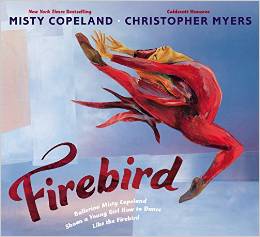
    I have been eagerly awaiting the publication of this book! The book brings together two powerhouses – the professional ballerina Misty Copeland and children's book author and illustrator Christopher Myers.

    Copeland created a poetic text to highlight the story of an older dancer encouraging a younger one. The book affirms the power of believing in somebody and her potential. It is a timeless message, and we always need more books on this topic. In the world of children's books on dance, we still need so many more books that portray children from a variety of backgrounds, showing that dance and the arts can be in everyone's lives and in their future. Children want to see themselves in a book and relate to the characters.

    Myers's signature artwork – I believe a combination of collage and painting – just adds another layer to the power and beauty of this picture book. It is a must for your library collection.

    Check out Firebird today!

    ——————-

  • Alphabet Series: The Letter T

    When you and your students explore the letter T, these books can be springboards and inspiration for improvisation and dance projects.

    T is for Toe

    DownloadedFile 
    Eric Carle’s book From Head to Toe is a simple story that easily translates into a warm up exercise in a preschool or kindergarten class. As you read along, you and your students can wiggle, stretch, and bend different body parts, taking inspiration from animals.

    T is for Tall

    DownloadedFile-1       

    Like From Head to Toe, Denise Fleming’s In the Tall, Tall Grass is full of actions. You can read aloud as you ask your students to improvise around your classroom – darting, dipping, crunching, and munching. The words offer great variety and a sense of playfulness. 

    T is for Trucks

    Imgres

    Tip Tip Dig Dig - by Emma Garcia – also is filled with verbs to inspire an improv activity or group dance, this time taking inspiration from a variety of trucks. Students will love to lift, dig, and roll. 

    T is for Tuesday

    Imgres-1

    The Caldecott Medal book Tuesday by David Wiesner is a book with flying, sneaking frogs. Read the book to your class and then encourage them to "show you" the story through an improvised frog dance. Take notes on a white erase board or chart paper – noting how the students move. Select 6-8 movements to create a "sneaky frog dance" as a group. 

    Imgres-2

    Alphabet Books Too

    6a015431f12312970c01901e687323970b-320wi

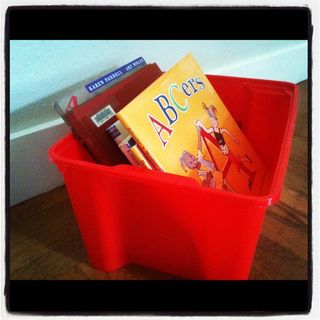
    As I suggested in the first post of this alphabet series, creating a book bin of alphabet books is a great idea. For example with the letter T, look at all of the "T pages" in your bin. Have students pair up, and give each pair one alphabet book. Ask them to find the T page. What movement or shape can they create related to that page? Give each pair a chance to share in front of the class. Again, you can string all of the ideas together to create a "T Dance."

    ——————

  • Alphabet Series: The Letter S

    When you and your students explore the letter S, these books can be springboards and inspiration for improvisation and dance projects.

    S is for Stomping

    DownloadedFile

    Stomp, Dinosaur, Stomp is full of playful action words to use with preschool, kindergarten, and first grade dancers. 

    "Mighty Tyrannosaurus loved stomp, stomp, stomping, gigantic legs striding, enormous jaws opening…."

    The book explores 11 different dinosaurs and a wonderful list of action words, including:

    • Stomping
    • Swishing
    • Gliding
    • Swooping
    • Soaring
    • Hunting
    • Pouncing
    • Zooming

    Use the book in a variety of ways to inspire improvisational activities, a "dino dance," or little vignettes about each animal in small groups.

    S is for "Someone Says"
    Imgres
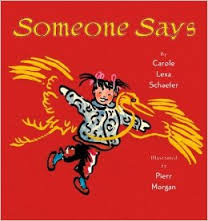
    I am a big fan of author Carole Lexa Schaefer and artist Pierr Morgan (listing two of their books here in this post). Someone Says is a delightful version of the simple game Simon Says. I like to read the book to the class and then make my own improv – a blend of freeze dance and Simon Says. I call it "Someone Says." We start to dance around the space to music. When the music stops, I call out a student's name and he/she decides how we will move next. "Olivia says, let's……" I give each student an opportunity to select a movement idea.

    S is for Squiggle
    Imgres-1

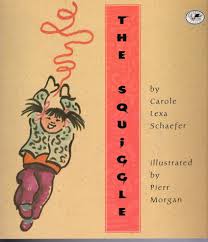
    Carole Lexa Schaefer and Pierr Morgan also created the book The Squiggle. In The Squiggle a red ribbon becomes many different things – ripples in water, a snake, and exploding fireworks. The book is easy inspiration for a dance with ribbons or scarves. How many different ways can we move? Can we move like _______? What animals and objects in our world can inspire us?

    S is for Skipping

    Imgres

    Skipping is one of the essential locomotor steps. Step hop, step hop, step hop….

    In Ready, Set, Skip! (by Jane O'Connor and illustrator Ann James), a girl shares all of the actions she can do, but skipping is currently not one of them. Then, her mother teaches her, and she is excited with this new action.

    Use the book as a lesson starter as you embark on skipping with your students.

    S is for Star Climbing
    Imgres-1

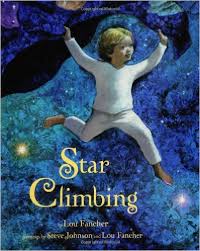
    Over the years, Star Climbing (Lou Fancher and Steve Johnson) is one of the picture books I have used most in dance classes. The words literally dance off the page and inspire a magical, whimsical project. A little boy dances amongst the stars:

    Tiptoe over low-lung clouds

    Leap from star to shining star

    Skip across bright silver stones.


    S is for "Silly Sally"
    DownloadedFile
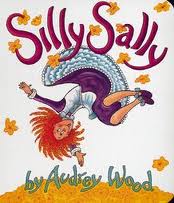
    "Silly Sally went to town, walking backwards, upside down." So begins this playful picture book by well-known children's author Audrey Wood. 

    The main character encounters different animals, and does a certain action with each one (a jig with a pig and leapfrog with a dog).

    One idea would be to create a whole dance using the entire text; another idea would be to read the book to your students and then play with some of the key concepts, especially ways of moving backwards and upside down. Use the book as a starting to point to explore many ways of moving backwards and upside down (or the concept of "direction" in general).

    S is for Seasons – Spring and Summer
    6a015431f12312970c019aff8b629e970c-800wi

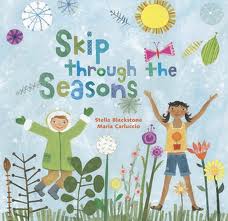
    I love books and poetry that explore the seasons. Over the years, I have written about numerous books with a seasonal theme. Check them out here.

    S is for Snow
    DownloadedFile
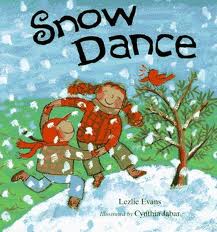
    Snow Dance, by Lezlie Evans with illustrations by Cynthia Jabar, is a great book for children in preschool through second grade. Can our dancing make it snow? What are all of the wonderful actions we do outside on cold days and snowy days?

    This book is simply a fun book to read during the winter months. You might also use this book as a springboard for a wintery dance. 

    Purchase a copy here.

    S is for Slow
    Imgres-2

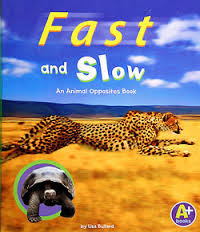
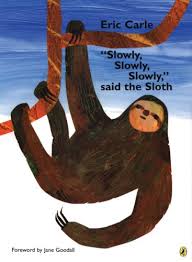
    The concept of fast and slow is always a source of play and joy with young ones. These two books can be read before you explore fast and slow with students. How can animals inspire us? 

    Fast and Slow: An Animal Opposites Book - Lisa Bullard

    "Slowly, Slowly, Slowly," said the Sloth - Eric Carle
    Imgres-3

    ——————–

  • Volcano Wakes Up!

    Imgres-2

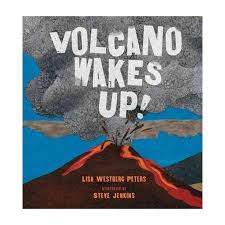
    Volcanoes move and dance. We too can take inspiration from their movement – brewing, exploding, pouring, oozing, and spreading. Explore this concept with students in 1st-4th grades.

    I love the book Volcano Wakes Up! by Lisa Westberg Peters and illustrator Steve Jenkins. Through a series of poems, a story of a brewing volcano is shared. Through five different perspectives – such as a cricket nearby and the sun and  moon – you learn about a Hawaiian volcano. 

    I suggest reading the whole book to your group. This can become your research and brainstorming. Write down words and images that come to mind. In small groups, can your students list 6-8 ideas from the book and make a vignette based on it? How can the students explore dynamic qualities, pathway, direction, and tempo? Or, take some of the short poems from the book, divide into groups, and create vignettes based on the poems. 

    You could also select several of the illustrations, in the same manner (about 6-8), to create a movement phrase. There is lots of potential within this single book.

    Have fun!

    ————

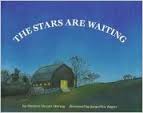
  • The Stars are Waiting

    Imgres-1

    While the book The Stars are Waiting is about 15 years old, the story is new inspiration to me. I recently stumbled upon it at the library. The text will inspire an improvisation or a dance project with students ranging in age from preschool through 2nd grade. I think the text beautifully pairs with exploring stopping and moving – dancing and freezing – with young students. It also lends itself to exploring shape, pathway, and entrances/exits.

    Over the hill, behind the moon, the stars are waiting…

    Waiting for wrens to quietly gather,

    Waiting for squirrels to cease their chatter. 

    Waiting for sparrows to end their flight,

    Waiting for day to fade to night.

    I feel that you could easily use the entire text for a project. Use the text to inspire solos, small group sections, or whole group dancing. The Stars are Waiting is being added to my list of "magic and whimsy" books to use with students in Prek-5. 

    The Stars are Waiting is by Marjorie Dennis Murray with illustrations by Jacqueline Rogers. Purchase a used copy here.

    ——————

  • Alphabet Series: The Letter R

    When you and your students explore the letter R, these books can be springboards and inspiration for improvisations and dance projects. R is for: red, ribbons, rainbows, raindrops, running, and rectangles.

    R is for Red

    Unknown

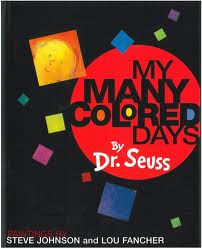
    To explore the color red, you can pull out all of your books about colors. Four examples include: My Many Colored DaysColourLiving Color, and The Rainbow Book. What are our associations with red? How can we translate these ideas into movement? Ideally, see if you can pull out 3-5 books on color. Look at the red pages, and then explore movement ideas related to these pages. You can even string the 3-5 ideas together.

    R is for Ribbons 

    Imgres-1

    Students love exploring props. Purchase some spools of ribbon at the local fabric or craft store (enough so that each student has a piece 24 inches in length).

    Carole Lexa Schaeffer's book The Squiggle is a favorite of mine. In the story, the ribbon becomes many different things and images. The book's text easily can translate into a dance.

    R is for Rainbows

    Imgres-2

    Surprisingly, there are only a few children's stories related to rainbows. The two that I keep coming back to for dancing inspiration are:

    Purchase some reasonably priced tulle at the fabric store in a variety of rainbow colors.

    Imgres-3

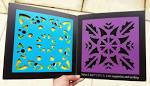
    As mentioned above, The Rainbow Book by Kate Ohrt is a unique addition to your collection of books about colors and emotions. Instead of images of people or animals, the art in the book is a series of paper cut outs, reminiscent of handmade snowflakes or Mexican cutout banners:

    Images-1

    The text on each page will inspire an improv, or help you create a group dance. "When I feel orange, I am energetic and strong…..When I feel blue, I am calm and peaceful."

    R is for Raindrops


    Unknown

    Rain is coming. You can feel it in the air. 

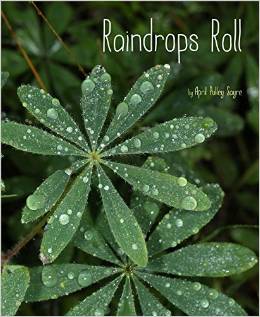
    So begins the new picture book Raindrops Roll by April Pulley Sayre. 

    With clear photographs and poetic text, this is an example of a book where the words literally dance off the page and inspire students to move. Most of the text can be directly used to create actions and movement phrases. Verbs include: plop, drop, patter, spatter, wash, weigh down, and thud. 

    Try out the instrumental song "Halinkata Djoubé" by Ballaké Sissoko and Vincent Siegel for your project.


    R is for Running

    6a015431f12312970c019b0033b223970d-800wi

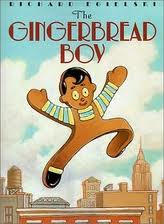
    "Run run run as fast as you can. You can't catch me. I'm the gingerbread man!" 

    So goes the classic chant from The Gingerbread Boy. I love Richard Egielski's version of the tale, this time taking place in the city. Even young students quickly catch on and remember the chant. (For the chant, I have the students run in place.)

    R is for Rectangles

    Imgres-4

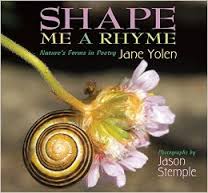
    Reference picture books and poetry books that talk about various shapes. From there, students can make rectangle shapes with other students. You can also make loops of elastic (about 4 feet in length) so that students can use the elastics to explore rectangles as well. 

    Books to reference include:

    Imgres-5

    —————————-


    —————-

  • A Full Moon is Rising

    Imgres

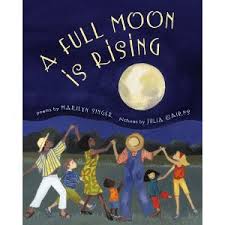
    I am a fan of poet/author Marilyn Singer, and her book A Full Moon is Rising will inspire magical and whimsical class projects this spring with students in 4th, 5th, and 6th grades.

    Marilyn Singer and illustrator Julia Cairns share stories, beliefs, customs, and celebrations from around the world related to the full moon. Each two-page fold includes a poem, art, and location in which this poem is located (New York City, Hong Kong, Australia, the Caribbean Sea). The book successfully conveys the idea that we all have this common link of a full moon. The book is a beautiful global study; in the back of the book there is an extra paragraph related to each region of the world to offer further details.

    I envision that you divide your class into several small groups of 1-4 students. Each group can create a vignette for one of the poems. String them all together. You can record your voice saying the poems or narrate them live. 

    This book pairs nicely with Rise the Moon.

    —————————-

  • Veloz como el grillo

    Imgres-1

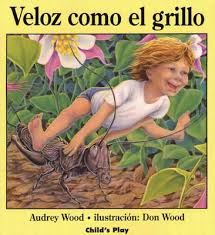
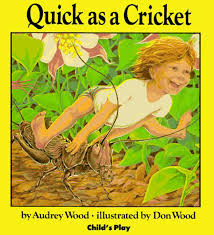
    I was thrilled to stumble upon this on the web this morning – the beloved book Quick as a Cricket by Audrey Wood and Don Wood, and in Spanish.

    Quick as a Cricket explores many similes and ways of moving – quickly, slowly, large, small, strong, weak. This picture book can be explored in preschool, kindergarten, and first grade classes.

    Purchase a copy in Spanish here.

    ————————

  • Alphabet Series: The Letter Q

    When you and your students explore the letter Q, these books can be springboards and inspiration for improvisations and dance projects. 

    Q is for Quick as a Cricket 

    Imgres

    Audrey and Don Wood's classic book Quick as a Cricket is a book of similes and a springboard for many ways of moving – quick as a cricket, slow as a snail, etc.

    You can explore the entire text with your students, and then hone in on "quick movements" as you focus on the letter Q. Brainstorm together all of the animals, vehicles, and machines in our world that move quickly. Also explore our body and body parts – how can you move your hands quickly….arms…hips….feet?

    Q is for Quiet

    Url

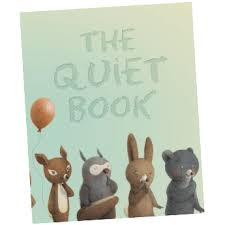
    The ALA Notable book The Quiet Book (Deborah Underwood and Renata Liwska) is a quirky picture book describing the many times in our life that we are quiet. Examples include:

    Hide-and-seek quiet

    Others telling secrets quiet

    Lollipop quiet

    Looking at the entire text – I don't feel that the whole book from beginning to end can work for a dance. But, you can definitely pull out several phrases as inspiration for movement exploration.

    You can also read the whole book, and then as a class come up with 6-10 different times that you are quiet, specifically honing in on ideas that can be conveyed through dancing.

    Using Your Book Bin of Alphabet Books

    6a015431f12312970c01901e687323970b-320wi

    As I suggested in the first post of this alphabet series, creating a book bin of alphabet books is a great idea. For example with the letter Q, look at all of the "Q pages" in your bin. Have students pair up, and give each pair one alphabet book. Ask them to find the Q page. What movement or shape can they create related to that page? Give each pair a chance to share in front of the class. Again, you can string all of the ideas together to create a "Q Dance."

    —————-

  • New Poems for Wintery Days

    Imgres-2

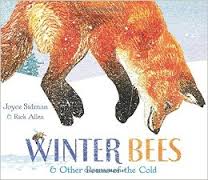
    I am always searching for books about the seasons. Winter Bees and Other Poems of the Cold is a great new addition with poems by Joyce Sidman and gorgeous illustrations by Rick Allen.

    The poems are suitable for students in grades 1-4. Sidman writes about the animals of winter, with unique poems about moose, tundra swans, and bees that can inspire dances in your classes. And, the poem "Snowflake Wakes" is a new favorite of mine – filled with moving words such as drifting down, settling, whirling, and "a pinwheel gathering glitter."

    Images

    ———————-