Blog

  • The Dance of the Raindrops

    Unknown-1

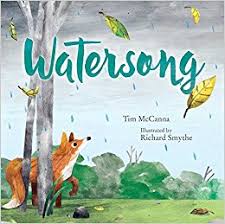
    One of my favorite themes for creative dance projects – spanning preschool through 6th grade – is the subject of water. I love the actions of water, the states of water, and the water cycle. Watersong by Tim McCanna and illustrator Richard Smythe is a great new addition to my collection, ideal to use with preschool, kindergarten, and first grade students.

    This picture book is filled with playful words to describe the sounds, speed, and qualities of water. 

    Drip drop plip plop

    pitter patter pat. 

    Twinkle sprinkle splatter splutter

    spitter spatter splat.

    The text can lead to an improvisational activity or a choreographic project with the group. Explore tempo, level, and quality changes. Use the words and your narration of the story to support the movement phrasing and slow, medium, and fast tempos. Water can move in so many different and playful ways.

    Unknown

    ——–

  • Transitions, Transformations, and Teamwork

    I have a growing collection of playful and quirky books about the transformation of objects. This theme has great potential in a dance class with students in 3rd-6th grades. Seasoned teaching artists – read on…..

    Imgres-2

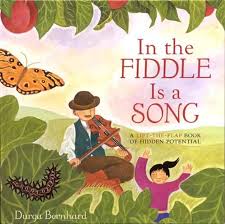
    Let me begin with Durga Bernhard's book In the Fiddle Is a Song. "In the acorn is a tree waiting to grow tall. In the clay is a pot waiting to be shaped." The poetic text, talking about 9 different items changing, can beautifully inspire a dance about transformation and transitions. Whether you have only one student at a time represent each page, or students work in small groups of 2 or 3, the project will challenge students to work on shapes, transitions, and changes in level, size, and quality.

    Imgres-3   Imgres-4   Imgres-5
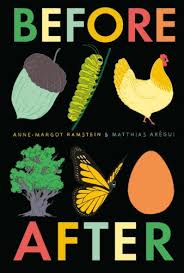
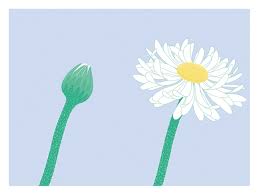
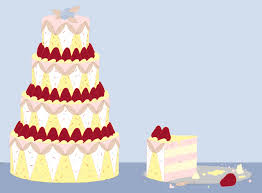
    Second, I love the wordless book Before After by Anne-Margot Ramstein and Matthias Arégui. Each spread shows two images – without text – challenging your imagination about the changes and transformations from A to B. Some are animals, and others are objects. Some examples include: a rocket ship/the moon, a deck of cards/a formation of cards, and a spider/a cobweb. If you have a group of students who improvise well together, you can use the book as a springboard for a group improv. Over the course of several classes, you could improvise with 6-10 of the pages.

    Imgres-1

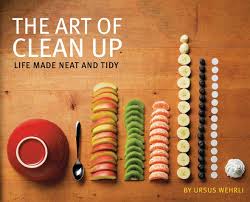
    Last, in a similar vein to Before After, there is the art book The Art of Clean Up by Ursus Wehrli. This photography book captures an item – such as a Christmas tree, sandbox at a park, or bouquet of flowers. Photo #1 is of the item; photo #2 is of the item taken apart and organized by shape, color, or size. Like Before After, this could lead to a group improv exercise exploring shapes. And, how do you transition from the first image into the second idea? It's a great exploration of re-organization.

    Imgres

    ——–

  • Jonathan and His Mommy

    6a015431f12312970c01bb0926ac80970d-320wi

    Several times a year, I have the wonderful opportunity to write for another blog, Book to BoogieThis month, I wrote about the picture book Jonathan and His Mommy. If you are looking for a book about parent/child relationships, pathways, and locomotor steps, check it out. Read more here

    —–

  • Water Is Water

    Imgres

    I am always on the lookout for great books about water and all of its actions and forms.

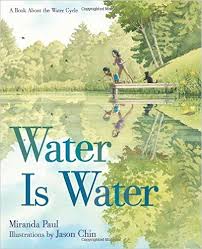
    Water Is Water, by Miranda Paul and illustrator Jason Chin, is an excellent addition to the collection. The words dance from one page to the next….full of action words, changing states, and a sense of play. 

    Read the book, list the action words, and create a dance. Or use the whole text and narrate the dance for your students.

    Misty.

    Twisty.

    Where is the town? 

    Fog is fog unless….

    it falls down.

    Patter.

    Splatter.

    What is that sound?

    Rain is rain unless…..

    Check out the book at your local library to read the whole story or purchase it here!

    —————

  • Up & Down, Big & Small: Opposites Can Dance

    Screen Shot 2016-02-20 at 9.38.11 AM

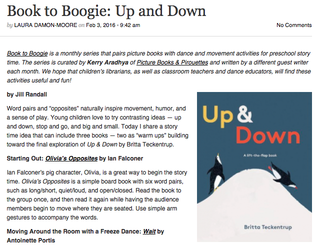
    Several times a year, I share ideas on the "Book to Boogie" Blog. Here's my latest post, exploring several books with word pairs and opposites. Try out these books in a parent/child class or preschool age creative dance class.

    http://www.libraryasincubatorproject.org/?p=17884

    —————-

  • Animal Action: Moon Forest by Patricia MacCarthy

    Imgres

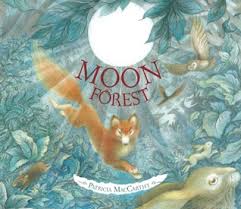
    Moon Forest was a great find recently at the public library. For teaching artists working with 2nd-5th graders – and larger sized classes of 10 or more – this story has lots of action and lots of "roles."

    A fox is traveling through a forest looking for food. Many animals interact and respond to the fox. The story so naturally lends itself to a dance, especially in a school setting with 20-35 children in a class. Develop the dance, and you can read the story aloud on stage. Your words and pacing can naturally cue the students.

    The story begins with:

    The great white eye of the moon looks into the forest. What can it see?

    A flitter of bats.

    A twist of briars.

    A dusting of moths.

    A coil of ferns.

    A red fox running through a blue forest…..

    An owl gliding between shadows.

    A warm breeze ruffling fur; a hunter's nose

    sniffing the sweet night air, 

    something stirring,

    a rat scuttling.

    Teaching artists can easily explore this book for several weeks in class, taking time to try out the many actions in the book. The story lends itself to exploring level changes, tempo, and a wide variety of locomotor and axial movements.

    Patricia MacCarthy's magical illustrations evoke traveling, swirling, dodging, and hiding within the forest. 

    Music ideas include songs from the album Chamber Music, a collaboration with a cellist and kora player (Ballaké Sissoko and Vincent Segal). Try out "Halinkata Djoubé."

    —————

  • Animal Inspiration: Group Dances

    Imgres

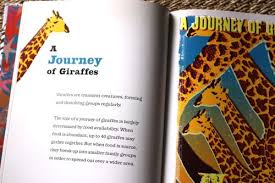
    In recent years not only 1 – but actually 3 – picture books have come out with the theme of collective nouns to describe groups of animals. What are these words and phrases? Examples include:

    • A leap of leopards
    • A parcel of penguins
    • A knot of frogs

    For students in grades 2-5, these books can be curious springboards for a group project. Divide the students into small groups of 3-6 students. Have them each select an animal and read up in that book about that animal. 

    Then, each group can create a section of the dance for their animal. For example,

    1. Have the students choreograph a way to enter into the space
    2. Students then freeze in a group shape/tableaux
    3. Then, based on their reading, have the students create a dance with 4-8 actions of their animal (example – reaching, swinging, grabbing, rolling, etc). Based on the age of your students, you can further explore level changes, tempo, direction, and pathway.
    4. Have the students choreograph a way to exit as well

    The three books of collective nouns are:

    A Tower of Giraffes: Animals in Groups by Anna Wright

    Have You Ever Seen a Smack of Jellyfish? An Alphabet Book by Sarah Asper-Smith

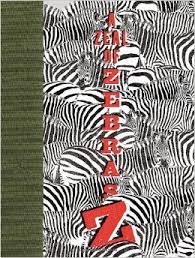
    A Zeal of Zebras by Woop Studios

    Imgres-1

    Image from A Zeal of Zebras

    Music ideas include:

    "Cirrus" by Bonobo

    "Thum Nyatiti" by Ayub Ogada

    "Rumble in the Jungle" by Max Roach

    ———————————

  • Swan: The Life and Dance of Anna Pavlova

    Images-6    Imgres

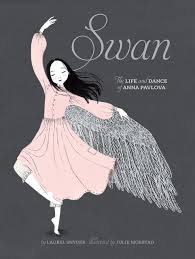
    The book cover alone will draw you into this new picture book about Anna Pavlova, considered one of the greatest ballerinas of all time.

    Sweet in tone and pictures, this book will be accessible and intriguing for dancers of all ages – from as early as age 4 up to age 11. Anna grew up in Russia with a single mother. Finally at age 10, she was accepted into the Imperial Ballet School. She rose to fame for her performance as well as belief that "ballet can be for everyone." 

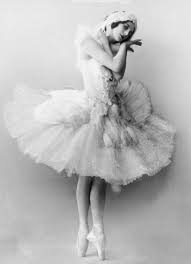
    To add to the reading experience, find photos of Anna Pavlova online via Google Images or Pinterest. She was stunning, and these vintage photos still convey her elegance. 

    Purchase Swan: The Life and Dance of Anna Pavlova by Laurel Snyder and Julie Morstad here or check it out at your local library.

    Images-4

  • Projects about the Four Seasons

    51EBZylmP6L._SX258_BO1,204,203,200_

    Quiet and still

    long enough

    for birds to make nests?

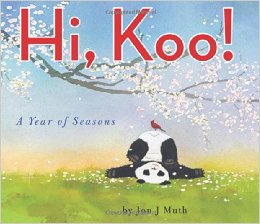
    This is one of the haiku poems we selected about spring, from the book Hi, Koo!: A Year of Seasons.

    In December, 15 7th and 8th graders in my Dance Elective course created a wonderful 60 minute production about the four seasons. We had several dances related to each season. The school's two choruses also joined us for the production. It was a beautiful collage of dance, song, poetry, and film. 

    We included several poems within the performance, with one student reading and 1-6 students dancing for each poem. Even in middle school, picture books with poems can offer ideas and inspiration. We pulled poems from:

    Hi, Koo! A Year of Seasons by Jon J. Muth

    Firefly July: A Year of Very Short Poems selected by Paul B. Janeczko

    Seasons: Rhymes in Time by Michael DeWall and Peter Elman

    If looking for new inspiration for a project this winter, check out these books! We especially loved the haikus as short interludes within the show. I also used these short poems as opportunities for brave students to try out solos and duets for the first time.

    ——————–


  • Magic and Whimsy Series: Touch the Brightest Star

     Images

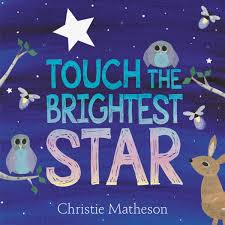
    Are you looking for new inspiration for a final dance/presentation in the coming weeks? If you teach students in preschool, kindergarten, and first grade – check out Christie Matheson's latest book Touch the Brightest Star

    Magic happens every night. It happens everywhere – from sunset to sunrise. It happens even when your eyes are closed. 

    So begins the book. 

    With each page turn, you will explore the actions of fireflies, wind, owls, and stars. The words are easy inspiration for movement.

    With your students, you can narrate the dance, directly reading the text. Develop movement phrases or an improvisational structure for the dance. 

    An idea for music is "Oscarine" by kora player Ballaké Sissoko and cellist Vincent Segal.

    ——————–