Blog

  • Guest Post: Wiggle by Taro Gomi

    Today's post was written by my friend and colleague Juliana Monin. Wiggle is a great new addition to your dance book collection and can be enjoyed at home, in a parent/child dance class, and in preschool classes.

    —————
    DownloadedFile

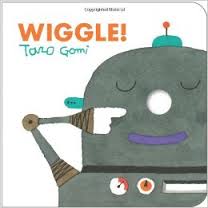
    Last week I came across Wiggle! by Taro Gomi and had to get it to try with the preschoolers I teach in Berkeley. They love impersonating animals, and I thought this might be a great way to get them to move from simply imitating animal movements into translating those movements into other parts of their bodies.

    The book has eight board pages, each naming an animal and describing the type of movement it is doing with a particular body part. For example:

    The elephant swings her trunk.

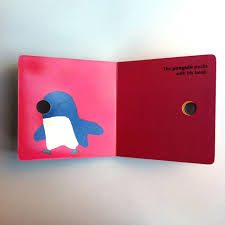
    The twist on this book is that there is a hole for the trunk (or fang, tail, wing, etc). 
    DownloadedFile-1

    Just reading the book has an active component as it requires one to use his or her own fingers to fill in the blanks of the story. A teacher or parent reading the book can allow the children to fill in the blanks as to what body part is missing by omitting the word while reading, thus encouraging body part identification.

    What I did was have one child come up for each page and place his or her finger through the hole to complete the action. The rest of the class followed along by imagining and simulating with their own body parts. I would ask the student at the front of the class to vary the way he/she was performing the action, and the rest would follow along. “Can you peck your beak slowly? How about quickly? Please shake your rattle up and down, now side to side.”

    Once we completed the book, students selected their own body parts and came up with a movement for that body part. The older students were able to name their body parts and name their movements. With the younger students, I had them point to a body part that we named and make up a movement that we also named. Movement names varied from the conventional “twirl” to the imaginative “super duper ninja jump.” Once a child demonstrated his or her movement, we all tried to do it the way he/she did it and then came up with ways of changing it. “Let’s make it move backwards. Do it in slow motion.”

    As a third part to this study, we returned to the original action words from the book, and instead of imitating the animals, we explored our own ways of wiggling or pecking or flapping.  “How do you flap your feet? Can you peck with your belly button?”

    This book was a wonderful way for me to introduce a concept and to develop it into further explorations. The kids loved it and so did I!

    ——-

    Juliana Monin began teaching creative movement in 2008 under the guidance and mentorship of Jill Randall. She has enjoyed teaching dance to diverse groups of people as a dancer with AXIS Dance Company (2011-2014) and is passionate about making dance accessible and relevant to all bodies. She is currently on faculty at Shawl-Anderson Dance Center and is creating a progressive and inclusive dance program at Bentley Upper School. 

    —————


  • Dancing During Poetry Month: Firefly July

    DownloadedFile-2

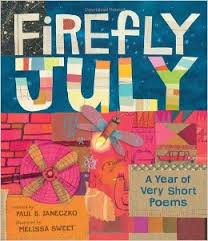
    Yesterday I got to stop into one of my favorite independent bookstores in the US, The King's English Bookstore in Salt Lake City. The new poetry compilation, Firefly July: A Year of Very Short Poems, was on display. 

    The book jumped out at me for various reasons:

    • Melissa Sweet's artwork is colorful and whimsical. 
    • I am always looking for new poems to use within dance classes.
    • I love poetry books that are categorized by seasons.
    • Upon a quick browse, I knew the content evoked a sense of "magic and whimsy."

    Paul B. Janeczko has compiled a strong collection of very short poems, perfect for 3rd-6th grade dance students. Poets include: Eve Merriam, Robert Frost, Jim Harrison and Ted Kooser, and Joyce Sidman. The brevity of the poems will lead to movement studies as well as a series of vignettes within a larger class, that could be strung together for a performance. For example,

    Spring

    Rain beats down,

    roots stretch up.


    They'll meet

    in a flower.

    -Raymond Souster

    Melissa Sweet's  illustrations and color scheme can also easily inspire costume selections.

    ———————-

  • Reblog: Book to Boogie Project

    Picture 4

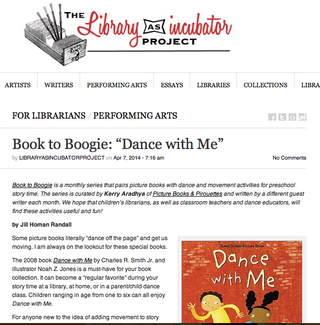
    This week, I am a guest writer for the Book to Boogie Project, which is a component of the Library as Incubator website. Book to Boogie explores books that can inspire movement activities during library storytime or in other venues with young children.

    My post explores the playful book Dance with Me

    Click here to read the post.

    ——————–


  • For Parent/Child Dance Classes: Flip, Flap, Fly!

    DownloadedFile

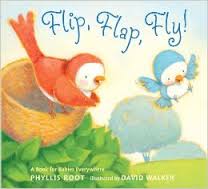
    I was thrilled to stumble upon Phyllis Root's book Flip, Flap, Fly! at the library this week. This book is perfect for a parent/child dance class with children ages 1-4. 

    The story explores numerous pairings – of a baby animal and its mother (fish, snake, bird, otter, etc). Each spread shares a different animal, and how the two move together. 

    The text can easily lead to an improvisational warm up or dance. 

    "Wiggle!"  hisses baby snake.

    "Wiggle with a squiggle!"

    So the mama helps the baby snake

        ziggle    zaggle    wiggle

    Have fun dancing together in a variety of ways. Let's flip, flap, fly…..let's splish, splash, swim.

    ———————-


  • A Dance Like Starlight: One Ballerina’s Dream

    DownloadedFile

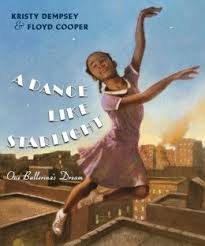
    I was thrilled to read this new book today, A Dance Like Starlight: One Ballerina's Dream by Kristy Dempsey and illustrator Floyd Cooper. 

    This picture book will be a great read to students in grades 2-4. It is partially a story of a child's dream, and partially the telling of the tale of Janet Collins, the first African American ballerina hired under contract to dance for the Metropolitan Opera in 1951. I myself learned a lot today reading this story.

    The main character in the book is a young girl with hopes and dreams. Her mother sews costumes for a ballet company in the tale. The story ends with the little girl and her mother getting to see Janet Collins perform on stage. 

    A Dance Like Starlight: One Ballerina's Dream is an excellent addition to children's literature on dance, and perfectly timed as we celebrate African American History Month in February. 

    ———————–

  • Still Time to Get This Book for a Valentine’s Day Dance Class

    Unknown-1

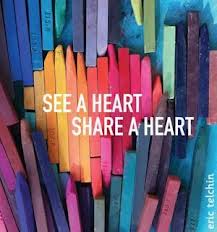
    My copy of Eric Telchin's See a Heart Share a Heart just arrived today. My 7th graders are excited to explore it next week in dance. I think the book can be used with a wide range of ages, with students in grades K-8. 

    Telchin photographed hearts found all around us – light that made the shape of a heart, plants, twisted items, and much more. But, the real inspiration for a dance class will be the poetic language:

    See a heart

    Share a heart

    Catch a heart

    Keep a heart

    In the text, approximately 20 different verbs are used. The language is rich with movement potential and many creative interpretations of the words (change, touch, share, tend, warm….). 

    You still have time to find copies, new  and used, through Powell's Books and Amazon.com

    ———————


  • Magic and Whimsy Series: There

    Imgres-2

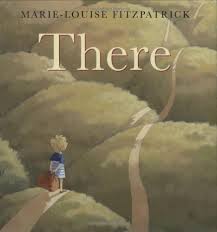
    For seasoned dance teaching artists who love multi-layered dance projects, check out the picture book There by Marie-Louise Fitzpatrick. This book can be used with a wide range of students in grades first all the way up to potentially middle school. 

    When will I get There?

    How will I know? Will there be a sign that says, "Here is There?"

    Will it take long to get There? Till tomorrow? Till next week? Next year?

    While you probably will not make movement directly with the text, the text can be a nice layer on top of a dance about journeys, travel, wishes and dreams, questions, and "what's next." You could record the text or narrate it live. 

    ———————————–


  • Alphabet Series: The Letter L


    Imgres-1

    LINES

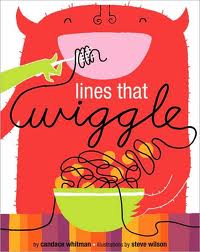
    Lines that Wiggle by Candace Whitman and Steve Wilson is a playful book with lots of examples of lines. Explore these lines by making shapes with your whole body, drawing in space, or making pathways with your feet.

    EXPLORE YOUR BOOK BIN OF ALPHABET BOOKS

    As I mentioned at the start of this series, I recommend having a book bin of alphabet books in your classroom or studio. That way, with letters like L, you might pull out a few books and simply look at the letter L. If the image is of a lion, can you lead an improv related to it? If the image is of a child low to the ground, can you explore multiple ways to move on a low level? Using a few of the books in the bin can lead to some easy warm up activities.

    —————-

  • Alphabet Series: The Letter K

    When exploring the letter K in your dance class or at your school, there are two joyful picture books that highlight informal dancing at home. It is powerful to share with young people the many styles of dance and the many ways that movement can be a part of our lives.

    Images-1

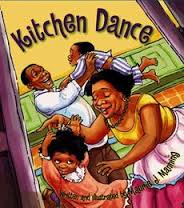
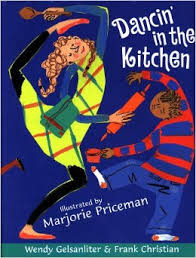
    Kitchen Dance by Maurie J. Manning shares the story of a mother and father dancing in their kitchen, with their children soon to follow. Dancin' in the Kitchen by Wendy Gelsanliter and Frank Christian uses rhyming text and Majorie Priceman's whimsical illustrations to convey the joy of a family cooking, eating, dancing, and enjoying music together. 

    Unknown-2

  • Other Blogs by Jill Randall

    From Blog Director Jill Randall:

    Thank you for being a regular reader of this blog, Dancing Words! I also maintain two other dance-related blogs you might want to check out.

    Life as a Modern Dancer: A blog geared towards college undergraduate students, sharing the many ways to have a life and career in modern dance. College departments around the United States use it as a "living textbook" in college courses. Click here.

    Dancers Using Technology: A blog highlighting the many uses of technology within dances, to promote dance, for dance education, and more. Click here.