Category: Reviews from Other Teaching Artists

  • Round by Joyce Sidman

    Today we are excited to have SF Bay Area teaching artist Juliana Monin writing for Dancing Words.
    Th-1

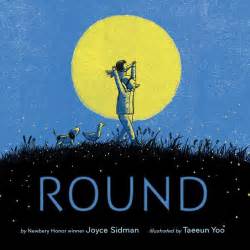
    My daughter received Round as a gift, and it’s filled with great images and ideas for dance. Written by Joyce Sidman and illustrated by Taeeun Yoo, Round is lyrical and dreamy, delighting in some of the ways we enjoy round things. It could be an excellent way to introduce a study of shape for preschool through 3rd grade.

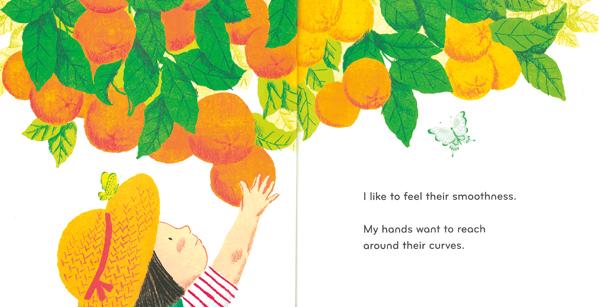
    Some inspirational images include: curving around round juicy oranges, round seeds quiet and still, swelling mushrooms, concentric rings of a tree stump, round ripples from rain drops onto water, and bubbles bursting.
    Image

    One favorite page depicting dung beetles says, "I love to watch round things move. They are so good at it! Rolling, spinning, bouncing. I always wonder where they’re headed.” Students can practice rolling on pathways with varying speeds, being “rolled” by someone, or rolling singular body parts.

    Another nice idea comes from two pages showing how water smooths out the edges of rocks over time. Students can practice several ways of transforming from angular shapes to curved ones.

    Other pages about friends linking together to make round circles, or hugging a loved one, lend to partnering explorations about round – loose and round, low and round…How big a round shape can you make? How small? How are you connecting?

    Round is sweet and serene, helping to remind us of the magic in our simple, natural, round world. I’ve been having fun dancing out some of these pages and think you will too.

    ——–
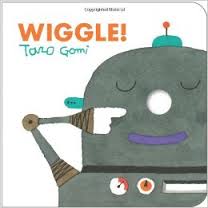
  • Guest Post: Wiggle by Taro Gomi

    Today's post was written by my friend and colleague Juliana Monin. Wiggle is a great new addition to your dance book collection and can be enjoyed at home, in a parent/child dance class, and in preschool classes.

    —————

    DownloadedFile

    Last week I came across Wiggle! by Taro Gomi and had to get it to try with the preschoolers I teach in Berkeley. They love impersonating animals, and I thought this might be a great way to get them to move from simply imitating animal movements into translating those movements into other parts of their bodies.

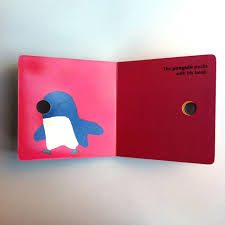
    The book has eight board pages, each naming an animal and describing the type of movement it is doing with a particular body part. For example:

    The elephant swings her trunk.

    The twist on this book is that there is a hole for the trunk (or fang, tail, wing, etc). 

    DownloadedFile-1

    Just reading the book has an active component as it requires one to use his or her own fingers to fill in the blanks of the story. A teacher or parent reading the book can allow the children to fill in the blanks as to what body part is missing by omitting the word while reading, thus encouraging body part identification.

    What I did was have one child come up for each page and place his or her finger through the hole to complete the action. The rest of the class followed along by imagining and simulating with their own body parts. I would ask the student at the front of the class to vary the way he/she was performing the action, and the rest would follow along. “Can you peck your beak slowly? How about quickly? Please shake your rattle up and down, now side to side.”

    Once we completed the book, students selected their own body parts and came up with a movement for that body part. The older students were able to name their body parts and name their movements. With the younger students, I had them point to a body part that we named and make up a movement that we also named. Movement names varied from the conventional “twirl” to the imaginative “super duper ninja jump.” Once a child demonstrated his or her movement, we all tried to do it the way he/she did it and then came up with ways of changing it. “Let’s make it move backwards. Do it in slow motion.”

    As a third part to this study, we returned to the original action words from the book, and instead of imitating the animals, we explored our own ways of wiggling or pecking or flapping.  “How do you flap your feet? Can you peck with your belly button?”

    This book was a wonderful way for me to introduce a concept and to develop it into further explorations. The kids loved it and so did I!

    ——-

    Juliana Monin began teaching creative movement in 2008 under the guidance and mentorship of Jill Randall. She has enjoyed teaching dance to diverse groups of people as a dancer with AXIS Dance Company (2011-2014) and is passionate about making dance accessible and relevant to all bodies. She is currently on faculty at Shawl-Anderson Dance Center and is creating a progressive and inclusive dance program at Bentley Upper School. 

    —————


  • Book to Boogie Blog: Fortunately by Remy Charlip

    Picture 3

    The Book to Boogie Series is another great blog to check out. Here is the recent post that explores a favorite of mine, Fortunately by Remy Charlip.

    Click here.


  • Guest Post: Dancers Among Us

    Images
    Today's post is from dance teaching artist Sheena Jeffers.

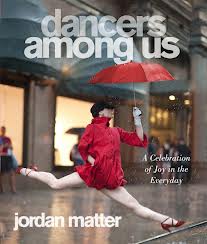
    Dancers Among Us, which has landed itself on the New York Times Best-Seller List, began as a project when photographer Jordan Matter observed his son playing with a toy bus. “I was trying to keep pace with this three-year-old mind as he got deeper and deeper into a fantasy involving nothing more than a yellow plastic box and armless figurines. At least that’s what I saw. He saw frantic commuters rushing to catch the 77 local bus to Australia.” 

    The book captures movement, dance technique and creativity and exhibits how those three qualities interact with our regular daily activity. 

    The book of photography, from photo shoots with professional dancers, is broken down into seven sections: Dreaming, Loving, Playing, Exploring, Grieving, Working, and Living. Each section contains quotes, stories and photographs of dancers interacting with the non-dancing world around them. 

    The book is a great conversation starter for young dance students because: 

    -The students can identify technique through the photograph: Are the legs extended? Toes pointed? What is their body placement? 
    -The students can discuss the visual representation of dance with the larger theme and idea: What atmosphere were they photographed in? What is going on? What is the connection to real life? What is the photographer trying to say?
    -The students can formulate their own opinions: What do they think of the image and the story? How does this relate to their personal lives? 

    There is a quote used in the book, that captures the energy running through each page: “I am a verb,” said by Ulysses S. Grant. The 229 page book, which also runs the reader through the development of each photograph, is fun and lighthearted even when tackling serious issues during the grief section. 

    Students, grades 6-12, will appreciate the photography, quotes and short stories as they see dance leap from the pages and into their personal lives. 

    Images-1

    Sheena Jeffers is a dance educator throughout Virginia. She is currently pursuing her Masters in Dance Education. She runs Ballet Shoes & Bobby Pins, a blog focused on initiating dance conversation and awareness for students, parents and dance admirers of all ages. Join the conversation; follow on Twitter: @BalletBobbyPins