Category: Preschool Dance Books

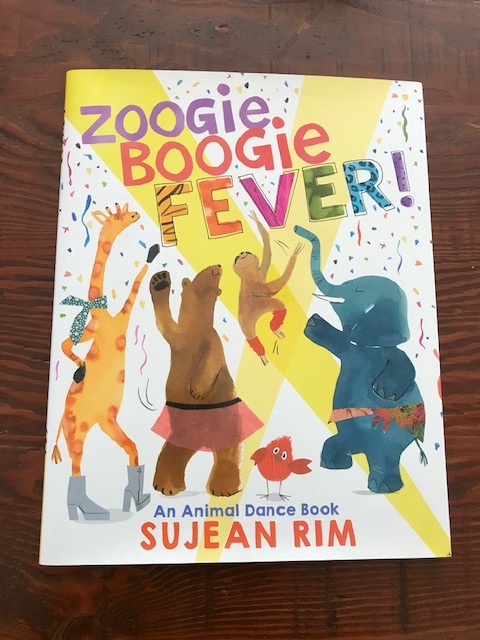
  • Zoogie Boogie Fever!

    Book cover

    This book was made for our dance classes! It works so magically with preschoolers' and kindergarteners' love of animal dances, imaginative play involving sneaking out and dancing at night, freeze dance games, and more. The words literally will narrate your group dance or structured improv for your class.

    The story will inspire swinging, swaying, jumping, and wiggling. We will move slowly and quickly. We will FREEZE when we don't want to get caught at the zoo….

    Musical selections can include bright jazz tunes like "Watermelon Man" by Herbie Hancock, "Seven Come Eleven" by Oscar Peterson, or "Salt Peanuts" by Dizzy Gillespie.

    Dance teachers – become the narrator of the book and let the words lead the sections of the dance (whether a culminating project or a recurring structured improv you repeat several times throughout the semester).

    Tease out the concepts of the book over several lessons:

    • Shapes/body positions
    • Various animals and how they locomote, plus the levels they move on (high/middle/low)
    • Fast and slow movement
    • Improvised movement/set steps
    • Naming steps/trying out new movement of your own that does not have a name
    • Dancing 2 by 2 across the space

    Purchase your copy of Sujean Rim's Zoogie Boogie Fever today!

    Boogie page

  • Round by Joyce Sidman

    Today we are excited to have SF Bay Area teaching artist Juliana Monin writing for Dancing Words.

    Th-1

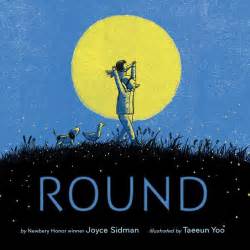
    My daughter received Round as a gift, and it’s filled with great images and ideas for dance. Written by Joyce Sidman and illustrated by Taeeun Yoo, Round is lyrical and dreamy, delighting in some of the ways we enjoy round things. It could be an excellent way to introduce a study of shape for preschool through 3rd grade.

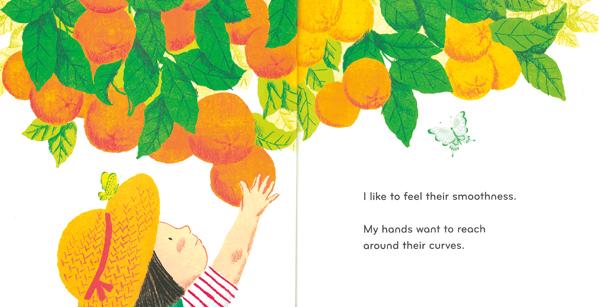
    Some inspirational images include: curving around round juicy oranges, round seeds quiet and still, swelling mushrooms, concentric rings of a tree stump, round ripples from rain drops onto water, and bubbles bursting.

    Image

    One favorite page depicting dung beetles says, "I love to watch round things move. They are so good at it! Rolling, spinning, bouncing. I always wonder where they’re headed.” Students can practice rolling on pathways with varying speeds, being “rolled” by someone, or rolling singular body parts.

    Another nice idea comes from two pages showing how water smooths out the edges of rocks over time. Students can practice several ways of transforming from angular shapes to curved ones.

    Other pages about friends linking together to make round circles, or hugging a loved one, lend to partnering explorations about round – loose and round, low and round…How big a round shape can you make? How small? How are you connecting?

    Round is sweet and serene, helping to remind us of the magic in our simple, natural, round world. I’ve been having fun dancing out some of these pages and think you will too.

    ——–

  • Dancing Off the Page: Leap, Frog, Leap by Douglas Florian

    IMG_0989 (1)

    Leap, Frog, Leap! is the third book in a board book series by Douglas Florian and illustrator Barbara Bakos. The words are simple, playful, and instantly lead to an improvisational exercise in parent/child and preschool dance classes.

    Leap, frog, leap!

    Creep, caterpillar, creep!

    Race, rabbit, race!

    Chase, cheetah, chase!

    Students will have the opportunity to explore 16 different actions – which will inspire level changes, varying qualities, and locomotor/stationary movement.

    For music, try out the instrumental/electronic piece "Circling" by Four Tet.

    —-

    Related posts:

    Dancing Off the Page: Bears are Big by Douglas Florian

    Dancing Off the Page: Flamingos Fly by Douglas Florian

    Blog Series: Parent/Child Classes

    ———————


  • Dancing Off the Page: Bears Are Big by Douglas Florian

    Th

    The other day I shared about Florian's book Flamingos Fly. Today I write about another book in the series, Bears Are Big. I am always on the lookout for books exploring opposites.

    Bears Are Big is a great new option to use with parent/child and preschool dance classes. Illustrator Barbara Bakos shares playful images of a variety of creatures. Use the ideas to create a warm up for your classes.

    Bears are big.

    Bees are small.

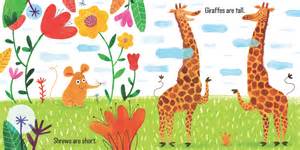
    Shrews are short.

    Giraffes are tall.

    I would like to offer two options with this particular text. 

    Option 1 – use the text from the beginning until the 12th page….ending with the idea, "Tree frogs stick." I think you can create a playful warm up that can be repeated for several weeks in a row.

    Option 2 – using the entire text – you will need some fabric. I have been exploring how to use the final set of words in the book, "Ravens are black. Doves are white." My solution is this: use the whole book, and then when you get to the last two pages about the birds, have your class come over to you and get black and white fabric. This can transition into an improvisational activity exploring the fabric and the bird inspiration of flying, flapping, soaring, opening, and closing. My top suggestion would be to head to the local fabric store to buy cheap tulle fabric in both black and white. 

    Th-1

    ———

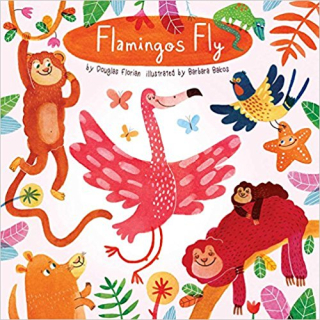
  • Dancing Off the Page: Flamingos Fly by Douglas Florian

    61rnvNyLtgL._SY498_BO1 204 203 200_

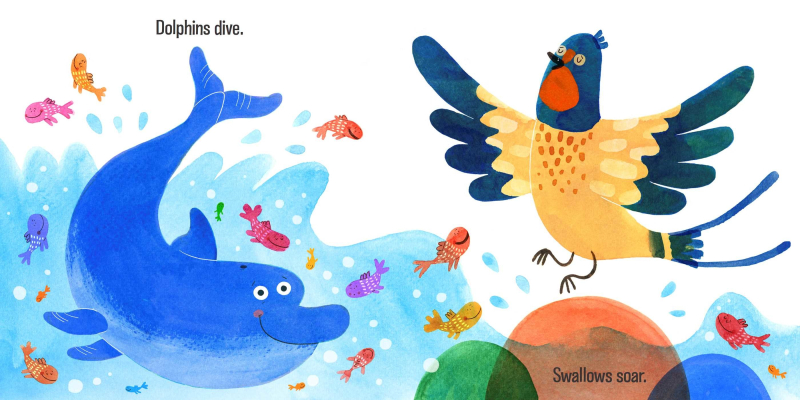
    Douglas Florian and Barbara Bakos have created four delightful board books to use in parent/child, preschool, and kindergarten classes. Use the ideas for improvisational activities or group dances. Today let's explore Flamingos Fly.

    "Flamingos fly. Sailfish swim. Monkeys swing in a jungle gym." Twelve ideas/actions are in this book:

    • Fly
    • Swim
    • Swing
    • Dive
    • Soar
    • Creep
    • Dig
    • Lunge
    • Plunge
    • Jump
    • Leap
    • Sleep

    Simple, clear, poetic, and varied. The students will explore a variety of traveling and stationary movements and level changes. Encourage the group to consider the timing and tempo for each kind of movement as well. For music, try out the instrumental piece "Biei (Ethereal Flow)" by Kodo.

    Image

    ——


  • Up & Down, Big & Small: Opposites Can Dance

    Screen Shot 2016-02-20 at 9.38.11 AM

    Several times a year, I share ideas on the "Book to Boogie" Blog. Here's my latest post, exploring several books with word pairs and opposites. Try out these books in a parent/child class or preschool age creative dance class.

    http://www.libraryasincubatorproject.org/?p=17884

    —————-

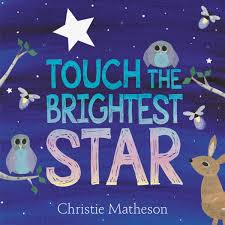
  • Magic and Whimsy Series: Touch the Brightest Star

     Images

    Are you looking for new inspiration for a final dance/presentation in the coming weeks? If you teach students in preschool, kindergarten, and first grade – check out Christie Matheson's latest book Touch the Brightest Star

    Magic happens every night. It happens everywhere – from sunset to sunrise. It happens even when your eyes are closed. 

    So begins the book. 

    With each page turn, you will explore the actions of fireflies, wind, owls, and stars. The words are easy inspiration for movement.

    With your students, you can narrate the dance, directly reading the text. Develop movement phrases or an improvisational structure for the dance. 

    An idea for music is "Oscarine" by kora player Ballaké Sissoko and cellist Vincent Segal.

    ——————– 


  • Article about Dance, Books, and Storytime Sessions With Young Children

    Screen Shot 2015-11-15 at 7.55.54 AM

    From Blog Director Jill Randall:

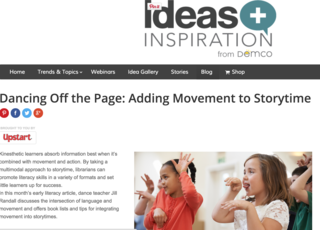
    I am happy to share my recent article about adding movement to storytime sessions with young children and families. Read it here:

    http://ideas.demco.com/blog/adding-movement-to-storytime/

    —————–

  • Book to Boogie Blog Today: Alphabet Movers

    Screen Shot 2015-10-07 at 3.33.14 PM

    I recently wrote about the book Alphabet Movers for the Book to Boogie Blog project, a component of the Library as Incubator website. 

    This is a great book to explore during storytime or within a dance class (parent/child or creative movement). 

    Read more here.

    ——————–

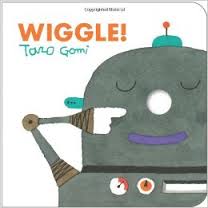
  • Guest Post: Wiggle by Taro Gomi

    Today's post was written by my friend and colleague Juliana Monin. Wiggle is a great new addition to your dance book collection and can be enjoyed at home, in a parent/child dance class, and in preschool classes.

    —————
    DownloadedFile

    Last week I came across Wiggle! by Taro Gomi and had to get it to try with the preschoolers I teach in Berkeley. They love impersonating animals, and I thought this might be a great way to get them to move from simply imitating animal movements into translating those movements into other parts of their bodies.

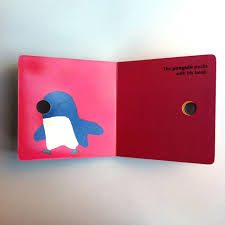
    The book has eight board pages, each naming an animal and describing the type of movement it is doing with a particular body part. For example:

    The elephant swings her trunk.

    The twist on this book is that there is a hole for the trunk (or fang, tail, wing, etc). 
    DownloadedFile-1

    Just reading the book has an active component as it requires one to use his or her own fingers to fill in the blanks of the story. A teacher or parent reading the book can allow the children to fill in the blanks as to what body part is missing by omitting the word while reading, thus encouraging body part identification.

    What I did was have one child come up for each page and place his or her finger through the hole to complete the action. The rest of the class followed along by imagining and simulating with their own body parts. I would ask the student at the front of the class to vary the way he/she was performing the action, and the rest would follow along. “Can you peck your beak slowly? How about quickly? Please shake your rattle up and down, now side to side.”

    Once we completed the book, students selected their own body parts and came up with a movement for that body part. The older students were able to name their body parts and name their movements. With the younger students, I had them point to a body part that we named and make up a movement that we also named. Movement names varied from the conventional “twirl” to the imaginative “super duper ninja jump.” Once a child demonstrated his or her movement, we all tried to do it the way he/she did it and then came up with ways of changing it. “Let’s make it move backwards. Do it in slow motion.”

    As a third part to this study, we returned to the original action words from the book, and instead of imitating the animals, we explored our own ways of wiggling or pecking or flapping.  “How do you flap your feet? Can you peck with your belly button?”

    This book was a wonderful way for me to introduce a concept and to develop it into further explorations. The kids loved it and so did I!

    ——-

    Juliana Monin began teaching creative movement in 2008 under the guidance and mentorship of Jill Randall. She has enjoyed teaching dance to diverse groups of people as a dancer with AXIS Dance Company (2011-2014) and is passionate about making dance accessible and relevant to all bodies. She is currently on faculty at Shawl-Anderson Dance Center and is creating a progressive and inclusive dance program at Bentley Upper School. 

    —————