Category: PreK-5 Dance Books

  • Dr. Seuss Books (Even With Middle School Students)

    Photo 2

    I love the Luna Dance Institute's TwitterMoves project on Twitter - 140 characters to convey a movement idea or warm up. Over the past few years, I have used the tweets numerous times with students in grades 5-8. I encourage dance teaching artists working with middle school students, high schoolers, and even college students to follow the Luna Dance Institute on Twitter, and to explore these cool movement activities within your classes. These short posts can inspire a warm up, group exploration, or even a concept for a full dance.

    A post from last week was:

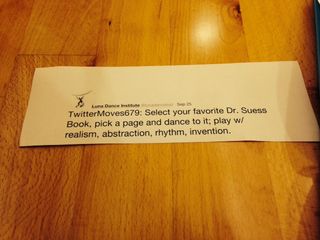
    TwitterMoves679: Select your favorite Dr. Suess Book, pick a page and dance to it; play w/ realism, abstraction, rhythm, invention.

    This morning, I quickly gathered a stack of Seuss books at our school's library. In my 7th/8th grade Dance Elective course (which has a theme this fall of dance and technology), we explored "inspiration from the internet." I printed out the tweet for the students.  

    In small groups, the students selected a book and used the language of the Twitter post to make a short movement sketch. We worked for about 10-15 minutes and then shared.

    You can easily try this out with students in 4th/5th, middle school, or even high school. My middle school students dove right in.

    Check out the Luna Dance Institute on Twitter. This TwitterMoves post in particular was a perfect blend of language and movement.
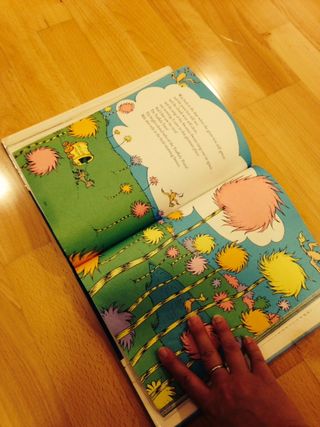
    Photo 1

    ————————-

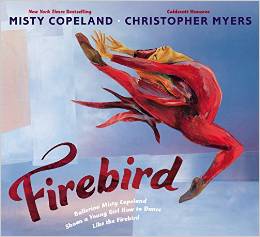
  • Firebird – by Misty Copeland and Christopher Myers

    Jpeg

    I have been eagerly awaiting the publication of this book! The book brings together two powerhouses – the professional ballerina Misty Copeland and children's book author and illustrator Christopher Myers.

    Copeland created a poetic text to highlight the story of an older dancer encouraging a younger one. The book affirms the power of believing in somebody and her potential. It is a timeless message, and we always need more books on this topic. In the world of children's books on dance, we still need so many more books that portray children from a variety of backgrounds, showing that dance and the arts can be in their lives and in their future. Children want to see themselves in a book and relate to the characters.

    Misty Copeland is an important figure in ballet in the United States. She is only the third African American soloist to perform in the American Ballet Theatre.

    Myers's signature artwork – I believe a combination of collage and painting – just adds another layer to the power and beauty of this picture book. It is a must for your library collection.

    Check out Firebird today!

    ——————-

  • Rupert Can Dance

    Imgres-1

    For me, it is always a tough sell to use books about dance with animal characters. Some dance teachers love this….I am more of a skeptic.

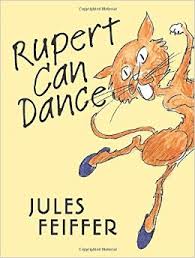
    This week, the imaginative cartoonist and author Jules Feiffer has won me over! This is now one of my favorite children's books for 2014 – a book entitled Rupert Can Dance.

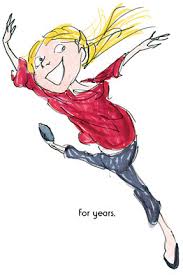
    Let me begin by describing the illustrations – excellent capturing of movement and the energy of dancing. This is seen in both characters – the young girl and the cat.

    Second, the storyline is just fun, and with a great message. Mandy is a girl who loves to dance, and her cat Rupert eagerly watches her. While Mandy sleeps, Rupert secretly dances. One day this secret is discovered. Mandy, excited, wants to teach Rupert about dancing. He does not want to be pushed into learning from her — a common feeling of many young students who want to do something on their own terms. With some "reverse psychology," Mandy gets Rupert to show her some moves, and then he opens up to experiencing dancing together. 

    Check out Rupert Can Dance for the artwork and the positive message of the story.

    Images

    ——————————-

  • Deer Dancer

    Imgres

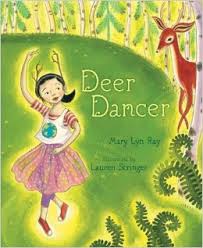
    Deer Dancer is a playful and sweet addition to our dance book collections.

    The book brings together an author and illustrator I love. Mary Lyn Ray also wrote the book Stars, which is a beautiful story to explore in dance classes with 3rd-5th graders. (My 7th and 8th graders even made a dance based on the story.) Lauren Stringer  also illustrated the unique and informative book When Stravinsky Met Nijinsky.

    In Deer Dancer, a hesitant and awkward young dancer finds a quiet place outside to dance, explore, and build confidence. She meets up with a deer, and a playful dance dialogue ensues. The story actually captures many wonderful ideas around confidence, being a dance student, and finding a place in our lives to “try ideas on.”

    For schools that use the social-emotional curriculum called the Toolbox Project, I think this book can be a nice addition to your program and conversations with students.

    ———————

  • The Bunnies are Not in Their Beds

    DownloadedFile-1

    For many dance teaching artists who work with preschool and kindergarten students, we have an  improv that has a format like the following. Whether it is statues in the garden, or toys in a toystore, the students pretend to be still when we — the gardener or store owner — come by. When our back is turned, the students come alive and dance all around. The students LOVE these dance games.

    I recently found another story that can inspire a new take on this improv. The book — The Bunnies are Not in Their Beds — tells of bunnies who are put to bed for the evening but keep getting caught playing in their rooms. In the story, the bunnies play with trains, cars, horses, and instruments. You can riff off of each idea and get the students scooching on the floor, galloping, marching, and more. 

    Check out The Bunnies are Not in Their Beds by Marisabina Russo.

    —————–


  • Lupita’s First Dance/El primer baile de Lupita

    DownloadedFile

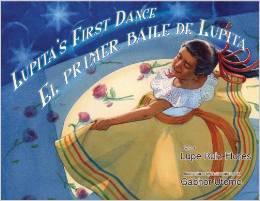
    I was excited to see this book on display at the library this summer. It is a great story to share with kindergarten and first grade students. With beautiful watercolor illustrations – and text in both Spanish and English – Lupita's First Dance shares a story about a young girl in first grade.

    Lupita's class is learning "La Raspa" for an upcoming performance. Excited about the dancing, costume, and performance, Lupita is an eager, young dancer. The night of the event, unfortunately, Lupita's partner does not show up. This is a common problem to juggle with young students – what do you do if your partner does not make it to the final performance? 

    Lupita bravely performs "La Raspa" as if her partner was there. She was proud and loved performing. The message of Lupita's First Dance is a great one to discuss with young students.

    Lupita's First Dance is by Lupe Ruiz-Flores with illustrations by Gabhor Utomo.

    ———

  • Dancing During Poetry Month: Firefly July

    DownloadedFile-2

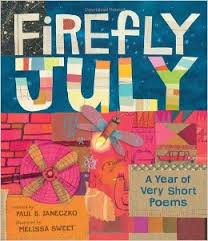
    Yesterday I got to stop into one of my favorite independent bookstores in the US, The King's English Bookstore in Salt Lake City. The new poetry compilation, Firefly July: A Year of Very Short Poems, was on display. 

    The book jumped out at me for various reasons:

    • Melissa Sweet's artwork is colorful and whimsical. 
    • I am always looking for new poems to use within dance classes.
    • I love poetry books that are categorized by seasons.
    • Upon a quick browse, I knew the content evoked a sense of "magic and whimsy."

    Paul B. Janeczko has compiled a strong collection of very short poems, perfect for 3rd-6th grade dance students. Poets include: Eve Merriam, Robert Frost, Jim Harrison and Ted Kooser, and Joyce Sidman. The brevity of the poems will lead to movement studies as well as a series of vignettes within a larger class, that could be strung together for a performance. For example,

    Spring

    Rain beats down,

    roots stretch up.


    They'll meet

    in a flower.

    -Raymond Souster

    Melissa Sweet's  illustrations and color scheme can also easily inspire costume selections.

    ———————-

  • A Dance Like Starlight: One Ballerina’s Dream

    DownloadedFile

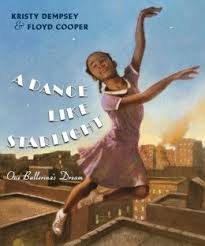
    I was thrilled to read this new book today, A Dance Like Starlight: One Ballerina's Dream by Kristy Dempsey and illustrator Floyd Cooper. 

    This picture book will be a great read to students in grades 2-4. It is partially a story of a child's dream, and partially the telling of the tale of Janet Collins, the first African American ballerina hired under contract to dance for the Metropolitan Opera in 1951. I myself learned a lot today reading this story.

    The main character in the book is a young girl with hopes and dreams. Her mother sews costumes for a ballet company in the tale. The story ends with the little girl and her mother getting to see Janet Collins perform on stage. 

    A Dance Like Starlight: One Ballerina's Dream is an excellent addition to children's literature on dance, and perfectly timed as we celebrate African American History Month in February. 

    ———————–

  • Still Time to Get This Book for a Valentine’s Day Dance Class

    Unknown-1

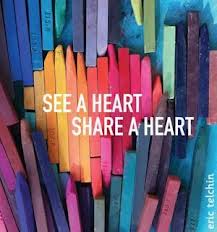
    My copy of Eric Telchin's See a Heart Share a Heart just arrived today. My 7th graders are excited to explore it next week in dance. I think the book can be used with a wide range of ages, with students in grades K-8. 

    Telchin photographed hearts found all around us – light that made the shape of a heart, plants, twisted items, and much more. But, the real inspiration for a dance class will be the poetic language:

    See a heart

    Share a heart

    Catch a heart

    Keep a heart

    In the text, approximately 20 different verbs are used. The language is rich with movement potential and many creative interpretations of the words (change, touch, share, tend, warm….). 

    You still have time to find copies, new  and used, through Powell's Books and Amazon.com

    ———————


  • Magic and Whimsy Series: There

    Imgres-2

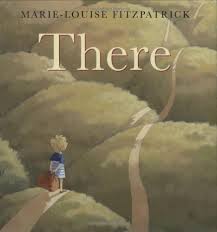
    For seasoned dance teaching artists who love multi-layered dance projects, check out the picture book There by Marie-Louise Fitzpatrick. This book can be used with a wide range of students in grades first all the way up to potentially middle school. 

    When will I get There?

    How will I know? Will there be a sign that says, "Here is There?"

    Will it take long to get There? Till tomorrow? Till next week? Next year?

    While you probably will not make movement directly with the text, the text can be a nice layer on top of a dance about journeys, travel, wishes and dreams, questions, and "what's next." You could record the text or narrate it live. 

    ———————————–