Category: PreK-5 Dance Books

  • Dr. Seuss’s Birthday

    Images-7

    Friday, March 2nd is Dr. Seuss's Birthday. We have some special activities happening at my school, and I will be leading a 45 minute lesson for 1st graders. 

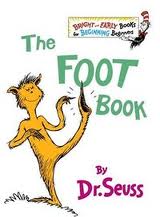
    I will be using The Foot Book as our inspiration for the day. I will be starting with a short name activity in the circle. On the board will be about 6 classic Dr. Seuss images of characters, selected for their interesting shapes. Each student will say her name and create in her body one of those shapes. The group will echo this back. 

    We will then sit to hear The Foot Book. 

    Exploring feet and the many ways our body can move, we will improvise, including:

    • Moving with slow feet and fast feet (either with a drum or using two pieces of music)
    • The many ways our feet can move: walking feet, kicking feet, jumping feet, hopping feet, pointing feet, flexing feet

    Last, I have created a short dance using the text – and the rhythm of the text – for the 1st graders. I will teach the dance, we will add music, and then we will perform it for each other (half of the class at a time). 

    If you try out any of the activities, please let me know!

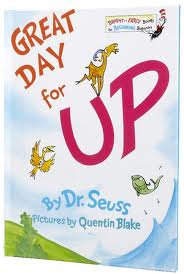
    In honor of Dr. Seuss's birthday, I also recommend A Great Day for Up for use with preschool students. It is a great springboard to explore up and down.

    Images-9

  • Chinese New Year

    Unknown-1    Unknown-2

    As many communities celebrate Chinese New Year and experience parades this coming weekend, I highly recommend sharing books about the amazing dragon dance. 

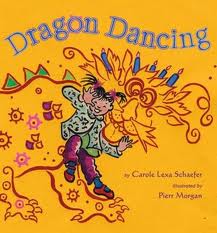
    I am a big fan of many books that bring together Carole Lexa Schaefer and Pierr Morgan. The stories are simple, whimsical, and have joyful illustrations. Dragon Dancing is a great book to share with students ages 4-7 (preschool and kindergarten).

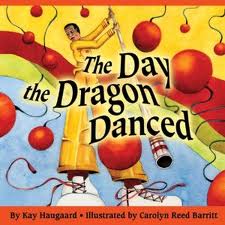
    For students in grades 1st, 2nd, and 3rd I recommend The Day the Dragon Danced by Kay Haugaard, illustrated by Carolyn Reed Barritt. This is a beautiful story of an African American family and their involvement in a Chinese New Year celebration, including the father being a part of the dragon dance. 


  • Beautiful New Biography: Alicia Alonso

    Images

    Alicia Alonso: Prima Ballerina is a great new addition to your or your school's biography collection. Author Carmen T. Bernier-Grand uniquely uses poetry form (free verse) to tell the story of Alonso's life in Cuba and in the United States. It tells her life story becoming a prima ballerina, moving to the United States, her struggle with her eyesight, and her move back to Cuba to found her own dance company and school.

    I am a fan of Raúl Colón's illustrations. You could even do a study of him as an illustrator, also looking at his books Jose! Born to Dance: The Story of Jose Limon and My Mama Had a Dancing Heart


  • The Graphic Alphabet by David Pelletier

    Images

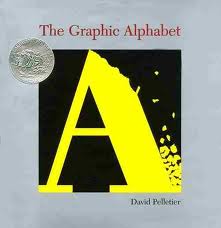
    I stumbled upon a fun alphabet book that could be a great springboard in classes. I would suggest this for 1st and 2nd grade students. The graphics are delightful, and the book is a Caldecott Honor Book. The words are a balance of nouns and verbs.

    In my mind, I foresee this turning into a dance with an entire class. Using one piece of music could unify the variety of ideas within the book. For each page, there could a short movement phrase. Over the 26 pages, there could be small group work and even solos/duets. The book's use of color could inspire simple costumes as well. 

    The word list includes:

    Avalanche

    Bounce

    Circles

    Devil

    Edge

    Fire

    Gear

    Hover

    Iceberg

    Juggle

    Knot

    Lines

    Mountains

    Noodles

    Ornaments

    Pipe

    Quilt

    Rip

    Steps

    Trip

    Universe

    Vampire

    Web

    Xray

    Yawn

    Zigzag

    You can purchase the book online from Mrs. Dalloway's Books in Berkeley, CA. (Support independent bookstores when we can!)

  • Snow Dance

    DownloadedFile

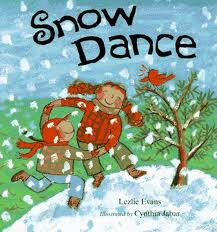
    Snow Dance, by Lezlie Evans with illustrations by Cynthia Jabar, is a great book for children in preschool through second grade. Can our dancing make it snow? What are all of the wonderful actions we do outside on cold days and snowy days?

    This book is simply a fun book to read during the winter months. Dance teaching artists might also use this book as a springboard for a wintery dance. 

    *Snow Dance is out of print. You can purchase a used copy through Powell's. I would also investigate your local library.


  • Wishes

    As we wrap up 2011, it is a wonderful time of year to think about our hopes and wishes for 2012.

    DownloadedFile-1

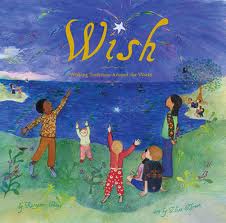
    I love the book Wish: Wishing Traditions Around the World by Roseanne Thong, with magical illustrations by Elisa Kleven. This book can be a perfect springboard for use in 3rd, 4th, and 5th grade dance classes. The book begins with the wonderful line, "How in the world do you make a wish?"

    After reading this book, students can talk about their own wishing traditions. What do you wish for? How do you convey your wish to the world? Is your wish a secret or shared with others?

    Seasoned dance teachers can use this in class for the start of a dance study or larger dance project with the theme of hopes and wishes. 

    *You can purchase this book through Mrs. Dalloway's Books in Berkeley. Let's keep supporting local, independent bookstores, even with our internet purchases.


  • Holiday Theme: Gingerbread Boys and Girls

    DownloadedFile  

    As many of us head into our last week of teaching, I wanted to share one of my favorite lessons with kindergarten and first grade students. 

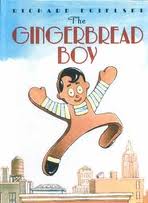
    I love using Richard Egielski's The Gingerbread Boy. I first read the story to the class. Then I have a loosely structured dance with the students dancing around town avoiding all those trying to eat him. We jump, skip, run, and tiptoe around town (lots of great locomotor movement). I love using the song "Watermelon Man" by jazz musican Herbie Hancock. All of the students easily catch onto the recurring verse, "run run run as fast as you can….". I have simple actions to go with this verse.

    Images

    I recently discovered the version The Gingerbread Girl by Lisa Campbell Ernst. I love how the words "jump" and "twirl" are in the recurring rhyme. 

    Check out your local library this week to use these books before winter holiday breaks from classes.


  • Boys Dancing

    Today, I wanted to share my favorite books that are about male dancers. While I love books that include both boys and girls, I do want to highlight boy-specific books today. 

    DownloadedFile-1 DownloadedFile

    Images

    Jonathan and His Mommy by Irene Smalls and Michael Hays is a joyful book for students 3-6. The child and his mother explore many ways of walking around town (tiny steps, zig zag steps, etc.). The book is a great exploration of pathway, as well as the concept of parent/child moving together.

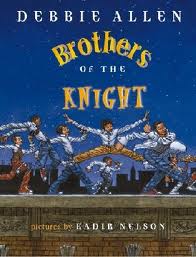
    Brothers of the Knight by Debbie Allen and Kadir Nelson is a wonderful male version of Twelve Dancing Princesses. I suggest this book for children 3-7.

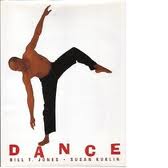
    One of my all-time favorite books on dance features the modern dance choreographer Bill T. Jones, simply entitled Dance. Bill T. Jones and Susan Kuklin created the book together. The text is such a beautiful, simple introduction to modern dance. Over the past ten years I have read this many a time to students in kindergarten and first grade. The photos of a strong male dancer are wonderful examples to my young students. I have used the text and images in the book for springboards for activities in K/1 classes. (The book is out of print but you can easily find used copies online.)

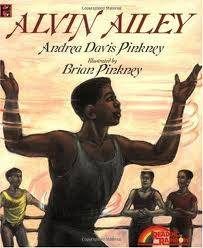
    Last, I would like to highlight 3 biographical/autobiographical books of famous choreographers Alvin Ailey and Jose Limon, as well as dancer Savion Glover:

    Alvin Ailey by Andrea Pinkney and Brian Pinkney

    Jose!: Born to Dance by Susanna Reich and Raul Colon

    Savion: My Life in Tap by Savion Glover and Bruce Weber

    If you have other favorites of books with male dancers, please leave a comment and I will gladly create a second post with further suggestions. 

    DownloadedFile-2  Images-1  DownloadedFile-3


  • Sometimes I Have Helpers: A Look at a Performance in Process

    Today's post is by my friend and colleague, Valerie Gutwirth. I have worked with Valerie for over 12 years now, and my 6 year old son is lucky to have her as his dance teacher at his public school.
      51PrAr2gLsL._SL500_AA300_

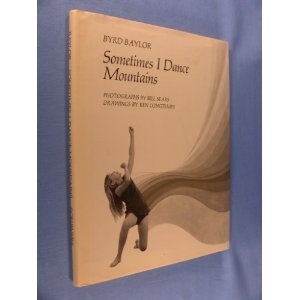
    Sometimes I Dance Mountains

    By Byrd Baylor

    Photographs and Illustrations by Bill Sears and Kenneth Longtemps


    This is an OLD book, and is currently out of print.*  But it’s message about the universality of movement, and the central place movement holds as a means of expression for young children, is just about perfect. When I first saw it, I was concerned about the little blonde white girl who is its only figure; reading it to my wildly diverse students, I find that it engages everybody.  I ask sometimes about why kids think the author and illustrators chose to include only this one child.  Answers range from, “she must have been one of their daughters” to “they probably just wanted one kid so it wouldn’t get confusing.”

    I read this almost every year to my first graders; last year’s reading was not until the end of the year.  They loved it, and were thrilled with the follow-up lesson, where kids choose parts of the book to dance.  As we said goodbye, a child in one class remarked wistfully, “next year’s first graders should really perform this book.”

    What a comment!  Foremost was this kid’s understanding that by the time he got back from the summer, this book might feel too young.  But I had never thought about the book as a performance piece; the work that comes out of it feels pensive, interior, and the lesson that goes with it really connects individually.  But since he said it – how could I not try? I decided to work on it this winter, as part of a unit on Dances From Nature.

    As October rolled around, and the structure and shape of dance in first grade got comfortable for my students, I took out the book – and then paused. How to introduce it in a way that could lead us to presentation?  How to scaffold the kids from the one figure in the book to groups of kids in the dance? Where did I want to go with this? Two weeks passed, and then three. 

    On the last Thursday of October, my third-grade class got ‘rained out’ of our usual space and sent back to the classroom. Instead of going with my usual rainy-day plan, I picked up Byrd Baylor and explained the situation: the first grade was going to perform the book, but I needed help figuring out how to structure the performance.  I read the book to 20 note-taking eight year-olds, many of whom had heard it as first graders.  The suggestions that emerged were brilliant. Here are a few:

    “You need two pictures for the back wall, one sunny and one rainy, and they have to slide so you can see one or both of them at different times.”

    “During the part with the bubbles, people need to blow bubbles onto the stage for the kids to dance with.”

    “The book has a pattern; a few pages with one idea on each page, then one page with, like, 6 ideas. Each one of those could be one group of kids.”

    “You have to help them find the words that are shapes, like mountain, and the words that move all around, like river – otherwise they’ll just run around and be crazy.”

    “You could give kids different colored scarves or ribbons to be the different things in the book, like rain or wind or heaviness.”

    “You need that thing they had in Comedy Of Errors (the 5th grade play from the previous winter), you know, that made all that mist??? The FOG machine!!” {this one I had to regretfully decline, with a reminder about six-year-olds’ developmental level}


    So I am on my way – I’ll be reading the book to first graders tomorrow.  I’m sure they’ll make their own brilliant interpretations, and the performance that emerges will be theirs.  But there will be third grade helpers blowing bubbles and sliding sets– and next year, I’ve promised those kids a fog machine for their fourth-grade dance performance.

     *Copies of the book can be found used at:

    http://www.amazon.com/gp/offer-listing/B000QGNEQA/ref=dp_olp_used_mbc?ie=UTF8&storeAttribute=b&qid=1321332155&sr=8-1&submit.see-all-buying-options=see-all-buying-options&condition=used


    Valerie Gutwirth teaches dance to K-5 in the Berkeley, CA public schools.
     

  • Harvest Dances

    DownloadedFile

    It is the perfect time of year to create dances inspired by the idea of harvesting and gathering, or to teach a culturally specific dance with this theme. 

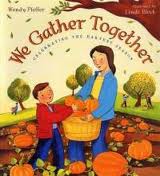
    I recently found at the library  We Gather Together by Wendy Pfeffer and Linda Bleck. It is a great complement to a lesson plan. 

    I would advise reading the entire book prior to class just to yourself, and then selecting  1/2 of the pages to share in a dance class setting. The text talks about harvests in many cultures around the world, and actually mentions several harvest based dances. 

    Linda Bleck's illustrations are well done in the book – fun, joyful, dancing images.