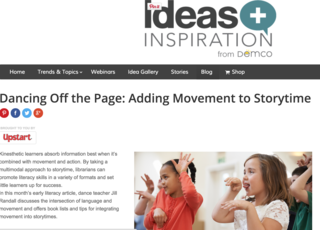
From Blog Director Jill Randall:
I am happy to share my recent article about adding movement to storytime sessions with young children and families. Read it here:
http://ideas.demco.com/blog/adding-movement-to-storytime/
—————–
From Blog Director Jill Randall:
I am happy to share my recent article about adding movement to storytime sessions with young children and families. Read it here:
http://ideas.demco.com/blog/adding-movement-to-storytime/
—————–
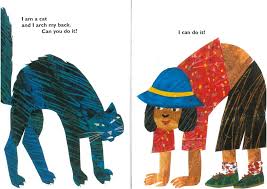
From Head to Toe by Eric Carle
By Jill Randall, Blog Director
From Head to Toe. Stomp, Dinosaur, Stomp. Bea at Ballet. These are three examples of picture books that I love using within dance classes.
Books add to the richness of the dance class experience for young children – offering them kinesthetic, visual, and auditory ways of learning. Especially with young children, we are always seeking those “ways in” for engagement and participation. You will be surprised how many children love a simple incorporation of a book within your dance program.
How did I begin my own love of adding books to my dance classes? I learned how to teach children from Mary Ann Lee of Tanner Dance in Salt Lake City (one of the largest creative dance centers in the United States). Mary Ann showed us the endless possibilities of picture books – how a simple story, or group of images, could lead to a magical 45 minute dance class. Books are such a simple and natural way to introduce a concept such as pathways, tempo, or a variety of locomotor steps through words and images.
From parent/child classes to fifth grade classes, many picture books can easily be used within a lesson. Some books have text that literally can be used to develop a group dance, while other books can be quick inspiration for an improvisation activity.
You might take 5 minutes to read the whole book, or simply show a few pages of a book as a visual.
I use books specifically about dancing but more often about other springboards for movement, including: the alphabet, animals, seasons, water, and nighttime. My favorite category of books is “magic and whimsy” – books that can be used mainly with 3rd-5th graders that capture bigger concepts such as love and togetherness through poetic text. In 1997, I saw Gigi Arrington lead a project with 3rd graders based on the book Sadako; that made a strong impact on me and modeled how to make a dance with children based on a book with a powerful message.
I encourage you to select a few titles and head to your local library for some resource gathering!
——–
Jill Randall is the Blog Director for Dancing Words (www.dancingwords.typepad.com). You can find hundreds of book titles on her site.
———————————-
Over the years, I have highlighted five great picture books for inspiration during the month of October. Inspiration comes from monsters, pumpkins patches, and spooky, sneaky moves.
Read more here and find books early at your library or used on amazon.com.
—————–

I recently wrote about the book Alphabet Movers for the Book to Boogie Blog project, a component of the Library as Incubator website.
This is a great book to explore during storytime or within a dance class (parent/child or creative movement).
Read more here.
——————–
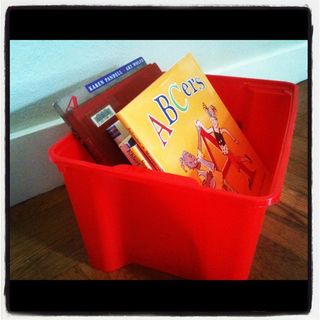
Over the past year, I have highlighted books to accompany each letter you are exploring with students. Here are links to all of the posts. As we teach one of the most important concepts to young children – the alphabet – let's explore it in a multimodal way that involves seeing, hearing, feeling, and moving so that all children can learn in their own way. Moving through the alphabet is playful and memorable. Click on any letter below to find books for your classes with preschoolers, kindergarteners, and first graders.

——————–
We have reached the letter Z! Yay! Let's zip and zigzag around. The letter Z will inspire us to explore pathways.

Here are four books to inspire moving in zigzags, straight lines, curving pathways, and much more. Explore zigzagging with your feet, hands, and arms.
1. Little Green by Keith Baker
A hummingbird – making various pathways in space (zig zag, curlycue, etc)
2. Jonathan and His Mommy by Irene Smalls and Michael Hays
A son and mother taking a walk and exploring all different ways to walk – big steps, small steps, zigzag pathways
3. Lines that Wiggle by Candace Whitman and Steve Wilson
An artistic exploration of lines that wiggle, bend, spiral, curve, etc.
4. Harold and the Purple Crayon by Crockett Johnson
An imaginative tale of a little boy drawing his world around him – the path he takes, the moon in the air, and much more to create an adventure
———————
No surprise – there aren't picture books to support studying the letter X! Wish there was one though. There are lots of great action words that include the letter X: extend, expand, explode….
Also, having students make Xs with their whole body is a simple and wonderful thing – whether on the floor or standing.
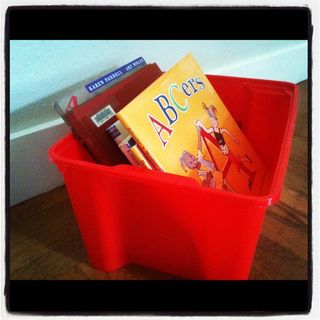
As I have suggested in several prior posts, creating a book bin of alphabet books is a great idea. For example with the letter X, look at all of the "X pages" in your bin. Have students pair up, and give each pair one alphabet book. Ask them to find the X page. What movement or shape can they create related to that page? Give each pair a chance to share in front of the class. Again, you can string all of the ideas together to create a "X Dance."
————————–
Many wonderful, movement inspiring words begin with W: water, waves, winter, and wind.
W IS FOR WATER
I love the theme of water and have explored it in many ways over the past 18 years in dance classes varying from preschool through 7th grade. Students explore the actions of water, the water cycle, forms of water, and more.
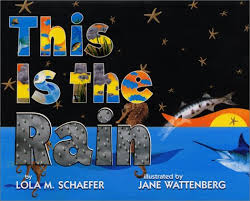
This summer at the library, I found the book This is the Rain by Lola M. Schaefer and illustrator Jane Wattenberg. This is the Rain is a cumulative story, like The House That Jack Built, where the story gets built upon.
As for movement inspiration, the book talks about the water cycle and the many forms/states of water. The use of repetition in the text is a great way to explore repetition in your dance class.
I encourage dance teaching artists, classroom teachers, and science teachers working with students in grades K-3 to check out this book. You can purchase used copies on amazon.com.
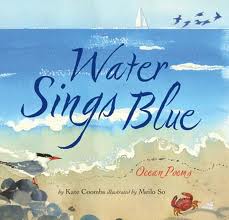
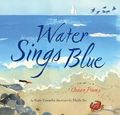
I have eagerly awaited a copy of this book in our local library system, and I finally checked it out recently. To my delight, Water Sings Blue: Ocean Poems, might be one of my new favorite children's poetry books to use in dance classes. The poetry is by Kate Coombs, with illustrations by Meilo So. Both text and paintings are full of magic, whimsy, and imagery to inspire movement with students ages 5-10.
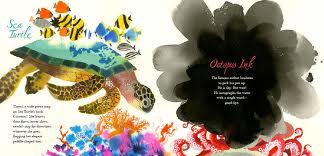
From start to finish, the poems take you on a journey along the shore and in the water. Topics include: sand, tide pools, waves, jellyfish, squid, and coral. The poems lend themselves to a variety of projects for both small groups (solos and duets) and whole group vignettes. You could easily use all or most poems in the book to create a beautiful performance with your class.
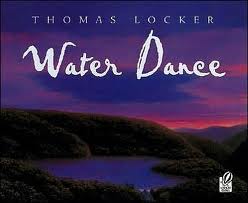
Thomas Locker's three picture books - Water Dance, Cloud Dance, and Mountain Dance - are great springboards for group dances. The use of the word "dance" refers to the changing of states, forms, and rises and falls within the natural world.
Water Dance is a book with poetic language. Each page describes a different form of water:
I wind through broad, golden valley
joined by streams,
joined by creeks.
I grow ever wider,
broader and deeper.
I am the river.
W IS FOR WAVES
This week I referenced the wordless book Wave by Suzy Lee. It inspired me to think more about ocean waves and how you can develop several dance lessons on this topic as well. Ocean waves are a creative way to explore up/down, calm/chaotic, forward/back, wavy pathways, and more.
I would recommend buying or borrowing photography books of ocean waves to explore with your students, such as:
W IS FOR WINTER
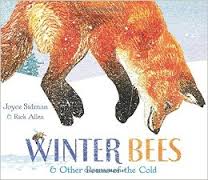
I am always searching for books about the seasons. Winter Bees and Other Poems of the Cold is a great new addition with poems by Joyce Sidman and gorgeous illustrations by Rick Allen.
Sidman writes about the animals of winter, with unique poems about moose, tundra swans, and bees that can inspire dances in your classes. And, the poem "Snowflake Wakes" is a new favorite of mine – filled with moving words such as drifting down, settling, whirling, and "a pinwheel gathering glitter."
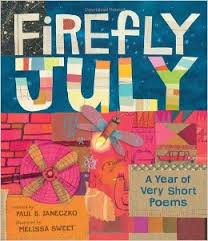
Yesterday I got to stop into one of my favorite independent bookstores in the US, The King's English Bookstore in Salt Lake City. The new poetry compilation, Firefly July: A Year of Very Short Poems, was on display.
The book jumped out at me for various reasons:
Paul B. Janeczko has compiled a strong collection of very short poems. Poets include: Eve Merriam, Robert Frost, Jim Harrison and Ted Kooser, and Joyce Sidman. The brevity of the poems will lead to movement studies as well as a series of vignettes within a larger class, that could be strung together for a performance. Melissa Sweet's illustrations and color scheme can also easily inspire costume selections.
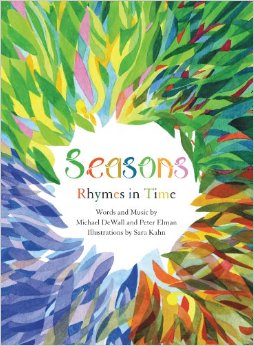
Bay Area educator Michael DeWall has created a beautiful book and CD to explore with children in preschool, kindergarten, first, and second grades. Illustrator Sara Kahn has created color-rich watercolors to accompany the lyrics of the songs. In the back of the book you will find the sheet music for these nine original songs as well as a CD.
The music is definitely "children's music," but I like it a lot. My own children are enjoying listening to it, and I can easily see PreK-2 dance teachers and classroom teachers using it in classes. The music is joyful and a great addition to your music collection about the seasons. The songs explore a variety of themes including: changes, rain, picking berries, and the four seasons.
Check out Seasons: Rhymes in Time here.
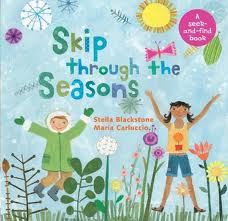
Stella Blackstone and Maria Carluccio created a fun, colorful, movement-filled book called Skip through the Seasons. "Jump into January….Fly into February….Race into June…." You can use the text to inspire a dance with students in K-2 classrooms.
W IS FOR WIND
There are numerous books to explore the concept, to inspire students to move "like the wind" – exploring the qualities of lightness and strong force, fast and slow,and over/under/towards/away. In your classes your students can explore being the wind or being moved by the wind.
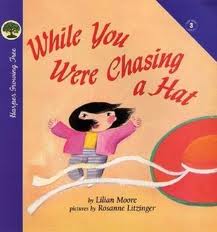
While You Were Chasing a Hat by Lilian Moore can be an easy introduction to the concept of wind and all that it moves in our world. Students in preschool and kindergarten will identify with the text, and the text can inspire a simple improvisation of being moved "by the wind."
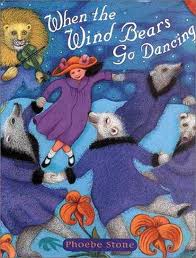
When the Wind Bears Go Dancing by Phoebe Stone is a playful book about the "wind bears in the sky." Again, children ages 4-7 will delight in hearing this story and creating a dance with you in class as you become the magical bears in the sky that make things move.
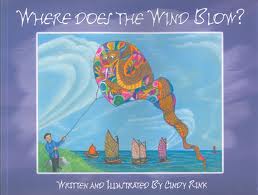
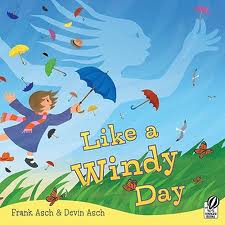
For students in K-2, there are two books with poetic text that could lead to beautiful group dances with a windy theme. I recommend both Where Does the Wind Blow? (Cindy Rink) and Like a Windy Day (Frank Asch and Devin Asch).
Wind can be a beautiful theme to explore along side, or instead of, your usual theme of the season of fall and leaves.
—————————-
V is for Volcano
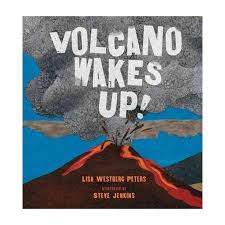
Volcanoes move and dance. We too can take inspiration from their movement – brewing, exploding, pouring, oozing, and spreading.
I love the book Volcano Wakes Up! by Lisa Westberg Peters and illustrator Steve Jenkins. Through a series of poems, a story of a brewing volcano is shared. Through five different perspectives – such as a cricket nearby and the sun and moon – you learn about a Hawaiian volcano.
I suggest reading the whole book to your group. This can become your research and brainstorming. Write down words and images that come to mind. In small groups, can your students list 6-8 ideas from the book and make a vignette based on it? How can the students explore dynamic qualities, pathway, direction, and tempo? Or, take some of the short poems from the book, divide into groups, and create vignettes based on the poems.
You could also select several of the illustrations, in the same manner (about 6-8), to create a movement phrase. There is lots of potential within this single book.
Alphabet Books Too
As I suggested in the first post of this alphabet series, creating a book bin of alphabet books is a great idea. For example with the letter V, look at all of the "V pages" in your bin. Have students pair up, and give each pair one alphabet book. Ask them to find the V page. What movement or shape can they create related to that page? Give each pair a chance to share in front of the class. Again, you can string all of the ideas together to create a "V Dance."
————————–
When you and your students explore the letter U, these books can be springboards and inspiration for improvisation and dance projects.
Up and Under
I am always on the lookout for picture books with prepositions. Prepositions are so fun to explore in movement with students in preschool, kindergarten, and 1st grades. You can explore relationships – over, under, around, and through – whether it is students dancing with a prop (hula hoop), students dancing together, or using imagery to inspire movement (ex. crawling through a tunnel).
Tana Hoban's classic picture book Over, Under, and Through is a great starting off point. Up, Down, and Around (Katherine Ayres and illustrator Nadine Bernard Westcott) is also a great exploration of prepositions as well as plants.
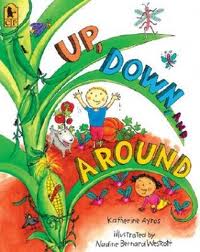
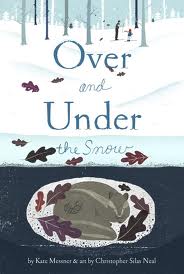
You might play with different parts, dividing the class into two to explore the "above ground" and "under the ground" ideas (such as in Over and Under the Snow by Kate Messner).
Underground
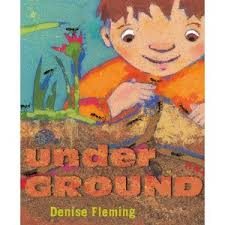
Many of Denise Fleming's picture books are fun to use in dance classes – full of action words and animal inspiration. Her latest book, Underground, is a wonderful new addition.
I have a small collection of books about plants and animals underground. This theme is fun to explore in preschool and kindergarten dance classes.
Use Fleming's new book to inspire improvisation activities or a group dance. This picture includes numerous animals and creatures that go underground – digging, tunneling, and burrowing.
Upside Down
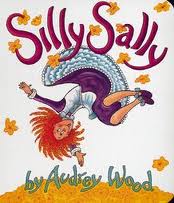
"Silly Sally went to town, walking backwards, upside down." So begins this playful picture book by well-known children's author Audrey Wood. The main character encounters different animals, and does a certain action with each one (a jig with a pig and leapfrog with a dog).
Use the book as a starting to point to explore many ways of moving backwards and upside down (or the concept of "direction" in general).
——————
 Dancing Words Blog