Today's post is by my friend and colleague, Valerie Gutwirth. I have worked with Valerie for over 12 years now, and my 6 year old son is lucky to have her as his dance teacher at his public school.
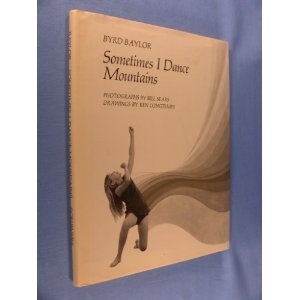
By Byrd Baylor
Photographs and Illustrations by Bill Sears and Kenneth Longtemps
This is an OLD book, and is currently out of print.* But it’s message about the universality of movement, and the central place movement holds as a means of expression for young children, is just about perfect. When I first saw it, I was concerned about the little blonde white girl who is its only figure; reading it to my wildly diverse students, I find that it engages everybody. I ask sometimes about why kids think the author and illustrators chose to include only this one child. Answers range from, “she must have been one of their daughters” to “they probably just wanted one kid so it wouldn’t get confusing.”
I read this almost every year to my first graders; last year’s reading was not until the end of the year. They loved it, and were thrilled with the follow-up lesson, where kids choose parts of the book to dance. As we said goodbye, a child in one class remarked wistfully, “next year’s first graders should really perform this book.”
What a comment! Foremost was this kid’s understanding that by the time he got back from the summer, this book might feel too young. But I had never thought about the book as a performance piece; the work that comes out of it feels pensive, interior, and the lesson that goes with it really connects individually. But since he said it – how could I not try? I decided to work on it this winter, as part of a unit on Dances From Nature.
As October rolled around, and the structure and shape of dance in first grade got comfortable for my students, I took out the book – and then paused. How to introduce it in a way that could lead us to presentation? How to scaffold the kids from the one figure in the book to groups of kids in the dance? Where did I want to go with this? Two weeks passed, and then three.
On the last Thursday of October, my third-grade class got ‘rained out’ of our usual space and sent back to the classroom. Instead of going with my usual rainy-day plan, I picked up Byrd Baylor and explained the situation: the first grade was going to perform the book, but I needed help figuring out how to structure the performance. I read the book to 20 note-taking eight year-olds, many of whom had heard it as first graders. The suggestions that emerged were brilliant. Here are a few:
“You need two pictures for the back wall, one sunny and one rainy, and they have to slide so you can see one or both of them at different times.”
“During the part with the bubbles, people need to blow bubbles onto the stage for the kids to dance with.”
“The book has a pattern; a few pages with one idea on each page, then one page with, like, 6 ideas. Each one of those could be one group of kids.”
“You have to help them find the words that are shapes, like mountain, and the words that move all around, like river – otherwise they’ll just run around and be crazy.”
“You could give kids different colored scarves or ribbons to be the different things in the book, like rain or wind or heaviness.”
“You need that thing they had in Comedy Of Errors (the 5th grade play from the previous winter), you know, that made all that mist??? The FOG machine!!” {this one I had to regretfully decline, with a reminder about six-year-olds’ developmental level}
So I am on my way – I’ll be reading the book to first graders tomorrow. I’m sure they’ll make their own brilliant interpretations, and the performance that emerges will be theirs. But there will be third grade helpers blowing bubbles and sliding sets– and next year, I’ve promised those kids a fog machine for their fourth-grade dance performance.
*Copies of the book can be found used at:
Valerie Gutwirth teaches dance to K-5 in the Berkeley, CA public schools.
 Dancing Words Blog
Leave a comment